
Ever picked up something and thought, “this feels almost weightless”? That’s probably close to 1 gram heavy. It’s one of the smallest units we use every day, yet most people can’t picture it without a scale.
This guide breaks down exactly how heavy 1 gram is, shows you 13 real objects that weigh about 1 gram, and even answers the one question most gram guides skip: what does 1 gram of gold actually weigh?
Table of Contents
How Heavy Is 1 Gram? (Size, Weight & Quick Conversions)
A gram is a metric unit of mass equal to 1/1000 of a kilogram. It was originally defined in 1795 as the mass of one cubic centimeter of pure water at its densest point, and that definition still holds true to within a tiny margin today (Wikipedia).
In plain terms: 1 gram is tiny. It’s about 0.035 ounces or 0.002 pounds. You could hold ten of them in your palm and barely notice the difference from holding nothing.
Here’s something most gram articles skip: weight and size are not the same thing. A gram of feathers takes up far more space than a gram of gold or steel, because density — how tightly packed the matter is — determines volume, not mass. So when people ask “how big is a 1 gram object,” the honest answer is: it depends entirely on what it’s made of.
Quick conversions:
- 1 gram = 1,000 milligrams
- 1 gram = 0.035 ounces
- 1 gram = 0.002 pounds
- 1 gram = 1 milliliter of water (by volume-to-mass equivalence)
- 1 gram = 5 carats (used in gemstone weighing)
One more distinction worth knowing: mass stays the same everywhere in the universe, but weight changes with gravity. A gram of anything would feel lighter on the Moon and heavier on Jupiter — but its mass, 1 gram, never changes.
13 Things That Weigh About 1 Gram
Instead of imagining a number, it helps to hold something familiar. Below are common, everyday objects that weigh close to 1 gram — some exactly, some approximately.
| Item | Weight | Quick Fact |
|---|---|---|
| US Dollar Bill | Exactly 1 g | Every denomination weighs the same, thanks to its 75% cotton, 25% linen blend |
| Standard Paperclip | Exactly 1 g | The most common household reference for 1 gram |
| Japanese 1 Yen Coin | Exactly 1 g | Made of pure aluminum — light enough to float briefly on water |
| Single Raisin | ~1 g | A dried grape that’s lost roughly 80% of its water weight |
| Thumbtack or Push Pin | ~1 g | Small enough to hold papers but still register on a gram scale |
| Stick of Chewing Gum | Exactly 1 g | Consistent weight across most gum brands |
| Ballpoint Pen Cap | ~1 g | Designed with tiny air vents as a safety feature |
| Pinch of Salt | ~1 g | The amount you can hold between two fingers |
| Small Birthday Candle | ~1 g | A 2-inch wax candle, give or take |
| Single Grape | ~1 g | Weight ranges between 0.8–1.2 grams depending on variety |
| Quarter of a Sugar Packet | ~1 g | A full restaurant packet holds about 4 grams |
| Plastic Bottle Cap | ~1 g | Lightweight polyethylene, produced by the billions each year |
| A Vitamin Tablet | ~1 g | Most standard multivitamin or supplement tablets fall in this range |
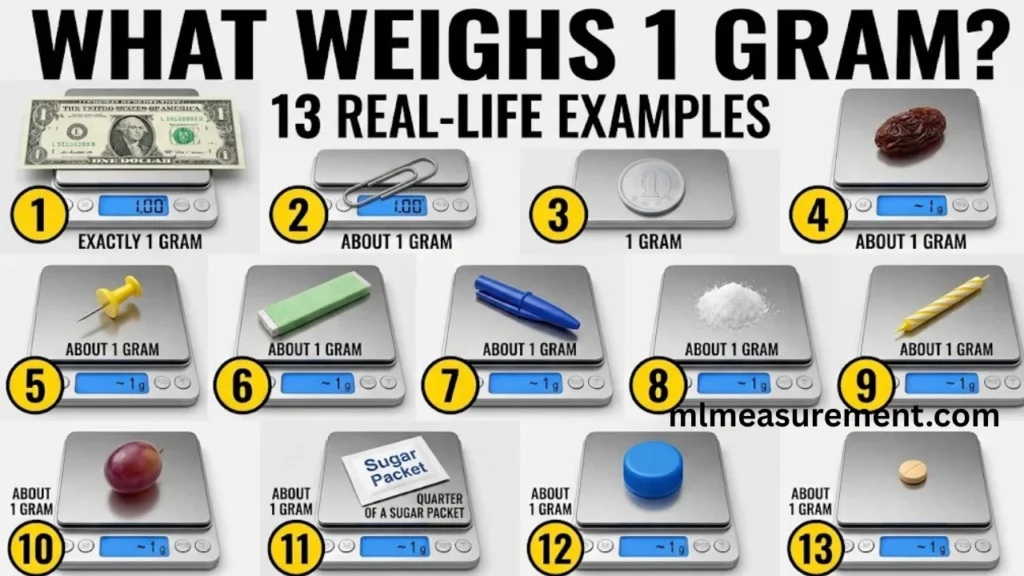
Notice the variety here — paper, metal, food, and plastic can all weigh the exact same amount. That’s the nature of mass: it doesn’t care what the material is, only how much matter is present.
Must visit: 10 Grams Heavy: 15 Real-Life Things That Weigh
How to Weigh 1 Gram at Home Without a Scale
Don’t have a scale handy? You still have a few reliable options.
The paperclip method is the simplest. Since a standard Gem-style paperclip weighs almost exactly 1 gram, you can use it as a hand-feel reference for comparing lighter or heavier objects.
The currency method works well for flat, paper-like items. Since every US bill weighs 1 gram, you can hold a dollar bill in one hand and the mystery object in the other to gauge relative weight.
The water method is the most scientifically accurate. Because 1 milliliter of water equals 1 gram, a measuring dropper or small syringe can double as a makeshift scale for liquids.
If precision actually matters — for cooking, crafts, or dosing — skip the guesswork. A basic digital pocket scale (usually $10–$20) measures down to 0.01 grams and is far more reliable than any DIY trick. And no, a smartphone cannot function as a gram scale — phones lack the pressure sensors needed to register such small mass differences.
How Much Does 1 Gram of Gold Weigh?
This is where things get interesting. 1 gram of gold weighs exactly 1 gram — mass doesn’t change based on material. But because gold is one of the densest common metals, a gram of it is noticeably smaller in size than a gram of paper, plastic, or wax.
Gold is typically traded and priced by the gram or by the troy ounce, which equals 31.1 grams — slightly heavier than a standard (avoirdupois) ounce of 28.35 grams (Wikipedia). This distinction matters for anyone buying jewelry or bullion, since gold weight is almost never quoted in standard ounces.
Gold prices shift daily with the market, so 1 gram of gold’s dollar value changes constantly — but its physical weight never does. If you’re ever comparing a “1 gram gold bar” to something like a paperclip, know that the gold version will feel dramatically smaller due to its high density, even though both share the exact same mass.
FAQs
How heavy is 1 gram?
1 gram equals 1/1000 of a kilogram, or about 0.035 ounces. It’s roughly the weight of a single paperclip, a dollar bill, or a small grape.
How big is a 1 gram?
There’s no fixed size for 1 gram — it depends on density. A gram of gold is much smaller than a gram of cotton or paper, because denser materials pack the same mass into less space.
How can I weigh 1 gram at home?
Use a standard paperclip or US dollar bill as a rough hand-feel reference, or measure 1 milliliter of water, which equals exactly 1 gram. For accuracy, a digital pocket scale is the best tool.
How heavy is 1 gram of gold?
1 gram of gold weighs exactly 1 gram — the same as any material. What differs is its size and market value, since gold is dense and priced per gram or troy ounce.
Conclusion
1 gram may be small, but it’s everywhere — in your wallet, on your desk, and even in your jewelry box. Once you know a few real-world references like a paperclip or a dollar bill, you’ll never need a scale to picture what 1 gram actually feels like.

Rehmaan Khan is a Measurement Content Researcher Specializing in MLmeasurement, Size Guides, Charts, and Simple Educational Measurement Content.