
Basketball court dimensions are 94 x 50 feet (28.65 x 15.24 m) in the NBA, WNBA and NCAA. FIBA courts are slightly smaller at 28 x 15 meters, according to Wikipedia.
This guide covers basketball court size by level, court markings, hoop height and court layout planning. Every number comes from published rule data.
Table of Contents
Basketball Court Dimensions by Level
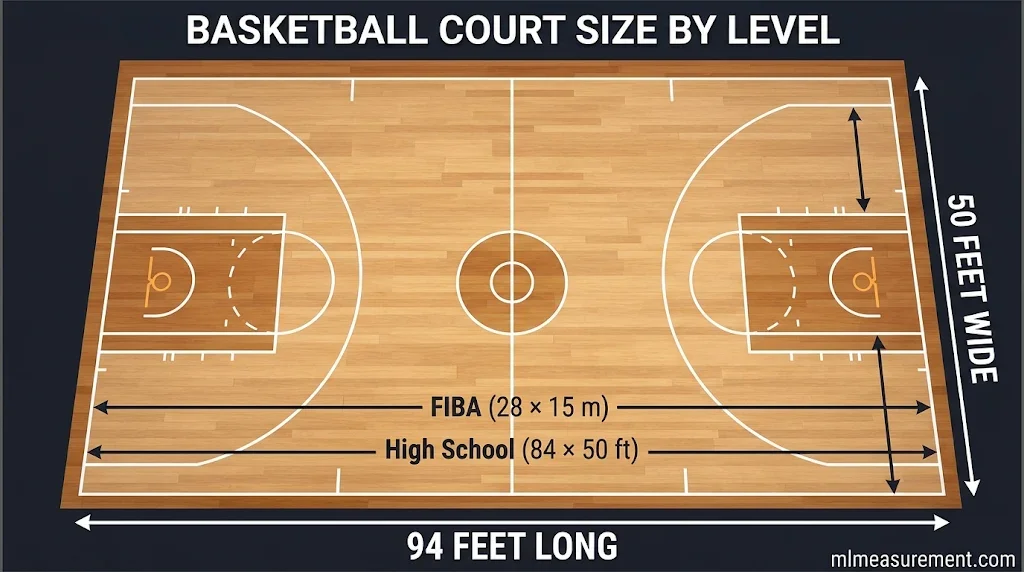
The regulation basketball court size changes with the level of play. The playing surface is a flat, hard rectangle with a basket at each end.
| Level | Length x Width (ft) | Length x Width (m) |
|---|---|---|
| NBA / WNBA / NCAA | 94 x 50 | 28.65 x 15.24 |
| FIBA (international) | 91.86 x 49.21 | 28 x 15 |
| High school (NFHS) | 84 x 50 | 25.6 x 15.24 |
| Junior high | 74 x 42 | 22.56 x 12.8 |
Sources: Wikipedia and Basketball-Goals.com.
What is the size of a high school basketball court? It is 84 feet long and 50 feet wide. Many older gyms are shorter. Wikipedia notes some run 74 feet in length.
A full NBA court covers 4,700 square feet (94 x 50). A FIBA court covers about 420 square meters, per Harrod Sport.
What is the correct dimension of the court? It depends on the league. Use the table above. For sanctioned play, always check the rule book for your level.
Basketball Court Markings and Lines
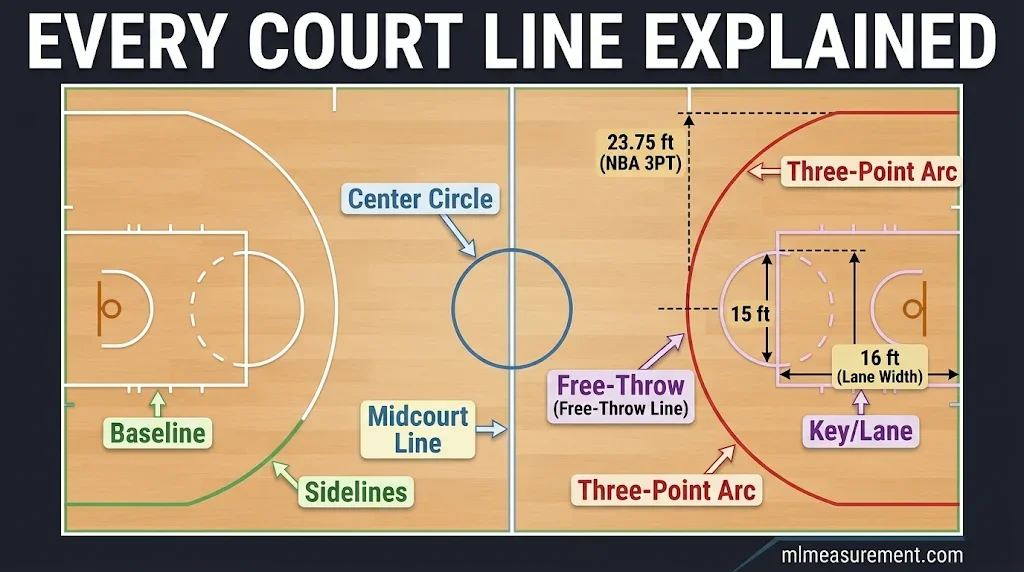
All lines are about 5 cm (2 inches) wide and one color, usually white, per Court Craft. The boundary lines are not part of the playing court.
While planning a basketball court, accurate measurements help ensure enough room for comfortable movement and proper layout. The same attention to dimensions matters when choosing a mattress, so understanding Nectar mattress sizes and dimensions can help you find the right fit for your bedroom and sleeping needs.
Here are the main court markings:
- Sidelines and baseline (endline): the outer edges. The baseline is usually 50 feet.
- Midcourt line: splits the court into two halves.
- Center circle: 12 ft across in the NBA and 3.6 m in FIBA. It is used for the opening jump ball.
- Free-throw line: 15 ft from the backboard plane in the NBA and 4.6 m in FIBA.
- The key (lane): 16 ft wide in the NBA, 4.9 m wide in FIBA and 12 ft wide in NCAA women’s play.
- No-charge arc: 4 ft in the NBA, 1.25 m in FIBA. NCAA women’s play uses 9 inches from 2023–24.
FIBA changed its key from a trapezoid to a rectangle (4.9 x 5.8 m) in 2010, per Wikipedia.
Three-point line distances vary by level:
- NBA: 23.75 ft at the top, 22 ft in the corners.
- FIBA and NCAA: 22.15 ft, with 21.65 ft in the corners.
- US high school: 19.75 ft.
The NBA added the three-point line in 1979–80. FIBA and the NCAA followed in 1986. NCAA men’s Division I moved to the FIBA arc in 2019–20, and women followed in 2021–22.
Also mark the team bench areas, throw-in lines and the coaching box. NBA floors place the coaching box 28 feet from each endline.
Blueprint tip: start with the boundary lines. Then mark the midcourt line, the key and free-throw lines, and the three-point arcs last.
Basketball Hoop, Backboard and Rim Height
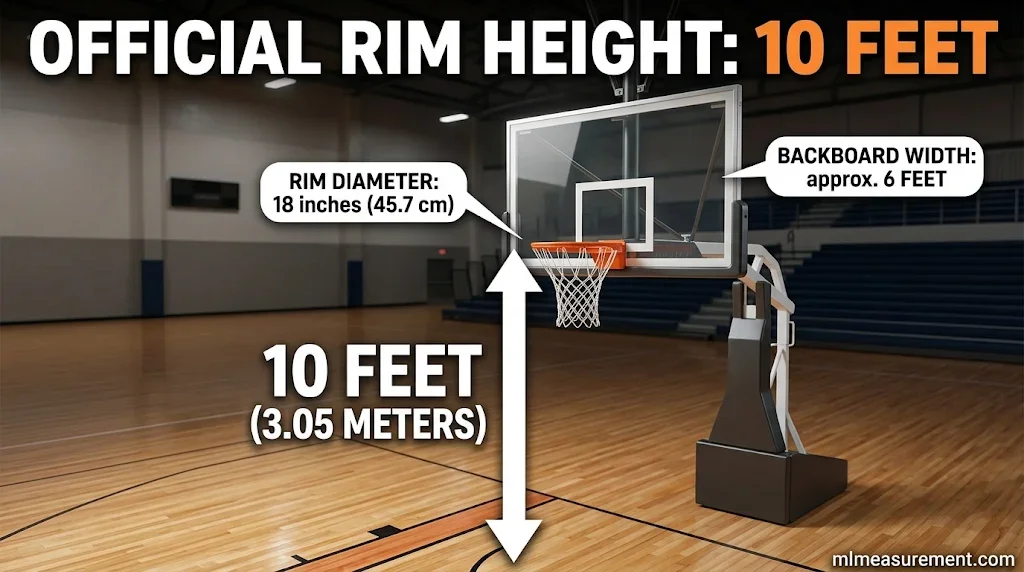
Is the NBA rim 12 feet? No. The rim is 10 feet (3.05 m) high in the NBA, the NCAA, FIBA and high school play, per Wikipedia. Only youth leagues may use lower hoops.
The rim measures about 18 inches (45.7 cm) across, according to Harrod Sport. Nets hang from the rim and are at least 45 cm long.
The backboard is about 1.8 m (6 ft) wide. It can be timber or transparent material, such as glass. FIBA allowed glass and LED courts for elite events in 2022, per SportsPro.
Goal systems come as wall-hinged, ceiling-mounted or free-standing. Check the pole padding on any goal system.
Court Space, Surface and Layout Planning
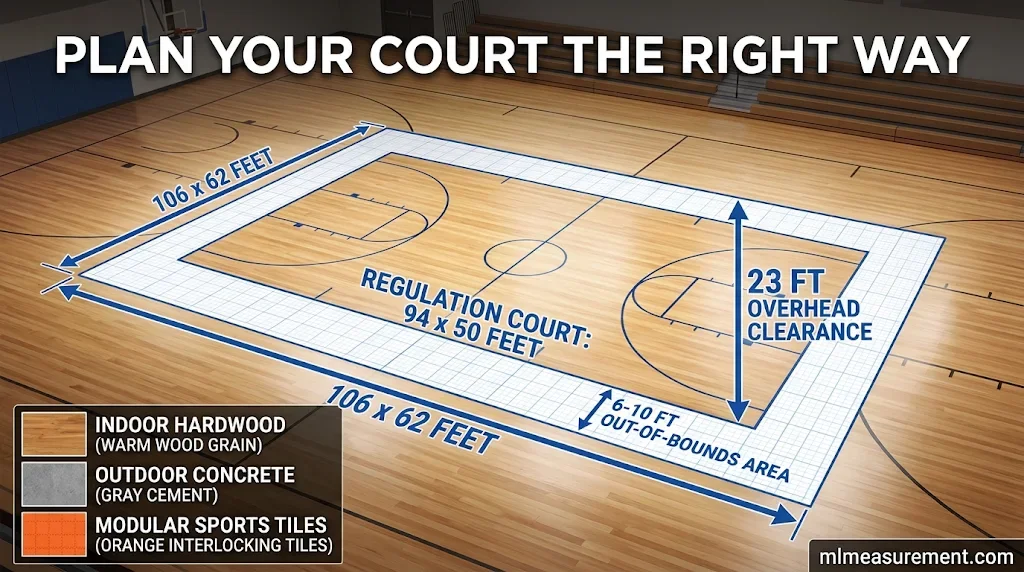
A court needs room beyond the lines. Court Craft says to keep at least 2 m around the court. Spectator seating should sit 5 m or more from the boundary lines.
Basketball-Goals.com suggests 6 feet of out-of-bounds space at minimum. It prefers 8 to 10 feet. A 6 ft border turns a 94 x 50 court into a 106 x 62 footprint, or 6,572 square feet.
Indoors, keep 7 m (about 23 ft) of clear height above the court.
Surface options:
- Indoor: polished maple hardwood is the standard.
- Outdoor: concrete or asphalt.
- Home courts: modular court tiles.
Is 30×30 big enough for a basketball court? It is not big enough for a regulation court. A 30 x 30 area is only 900 square feet. A half court is about 2,350 square feet (47 x 50).
A 30 x 30 space works well for one hoop, shooting drills and casual play. It can fit the free-throw line (15 ft) and a 16 ft key. A full 19.75 ft high school three-point arc would not fit across 30 ft.
Basketball-Goals.com notes that non-sanctioned gyms, such as YMCAs and church courts, can use any size. It still advises using proper lane lines.
Backyard layout checklist:
- Measure the full footprint, including run-off space.
- Check the surface slope and drainage.
- Plan the free-throw line and key first.
- Add the three-point arc only if the width allows.
FAQs
Is 30×30 big enough for a basketball court?
No, not for a regulation court. It is enough for one hoop and casual play. A half court needs about 47 x 50 ft.
What is the size of a high school basketball court?
It is 84 x 50 feet. Older gyms may be 74 feet long, and junior high courts are 74 x 42 feet.
Is the NBA rim 12 feet?
No. The NBA rim is 10 feet (3.05 m) high, the same as college and high school.
What is the correct dimension of the court?
The NBA and NCAA use 94 x 50 feet. FIBA uses 28 x 15 meters. High schools use 84 x 50 feet.
Conclusion
A regulation basketball court is 94 x 50 feet at the NBA and NCAA level, with a 10-foot rim. Match the size to your league, then leave room around the lines. Check your rule book before you paint.

Rehmaan Khan is a Measurement Content Researcher Specializing in MLmeasurement, Size Guides, Charts, and Simple Educational Measurement Content.