
A standard tennis court is 78 feet (23.77 m) long. It is 27 feet (8.23 m) wide for singles and 36 feet (10.97 m) wide for doubles. These tennis court dimensions come from the ITF Rules of Tennis, and the USTA follows them.
This guide covers tennis court size, layout, net height and the space you need around the court. It also compares tennis with padel and pickleball.
Table of Contents
Standard Tennis Court Dimensions (Singles and Doubles)
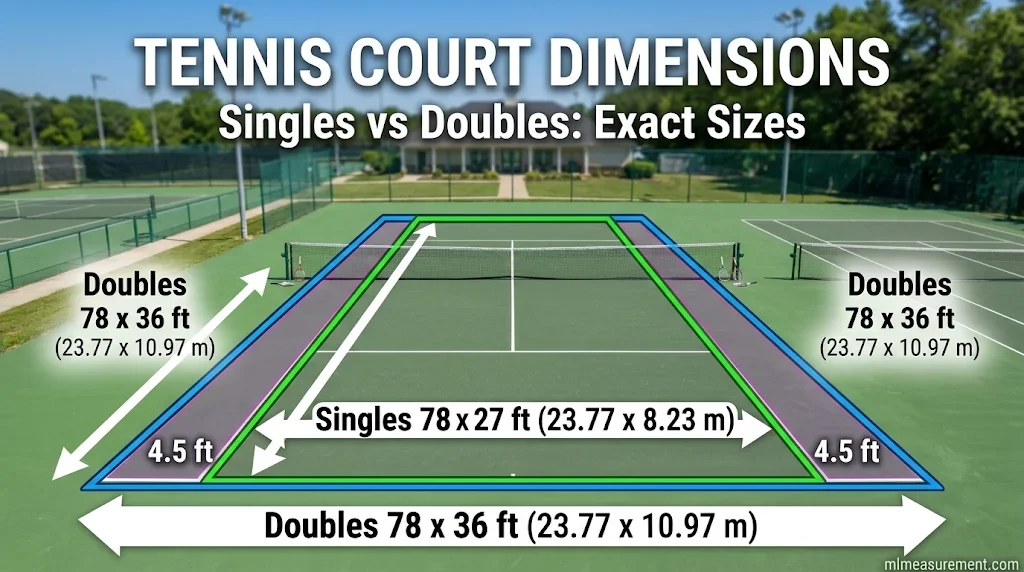
The court is a rectangle. The length stays the same for every match, and only the width changes. Measurements run to the outside edge of the lines, according to ASICS.
| Court type | Length | Width | Playing area |
|---|---|---|---|
| Singles court | 78 ft (23.77 m) | 27 ft (8.23 m) | 2,106 sq ft (195.65 m²) |
| Doubles court | 78 ft (23.77 m) | 36 ft (10.97 m) | 2,808 sq ft (260.87 m²) |
Area figures are from Harrod Sport.
The 9-foot gap between the two widths makes the doubles alleys, also called tramlines. Each alley is 4.5 feet wide.
The size is the same on hard, clay and grass courts. Only the bounce and speed change. ASICS notes that hard courts, made of asphalt or concrete, are the most common.
Tip: The ITF measures every court to the outside of the lines. Painters who measure to the inside lose width.
Tennis Court Layout and Line Markings
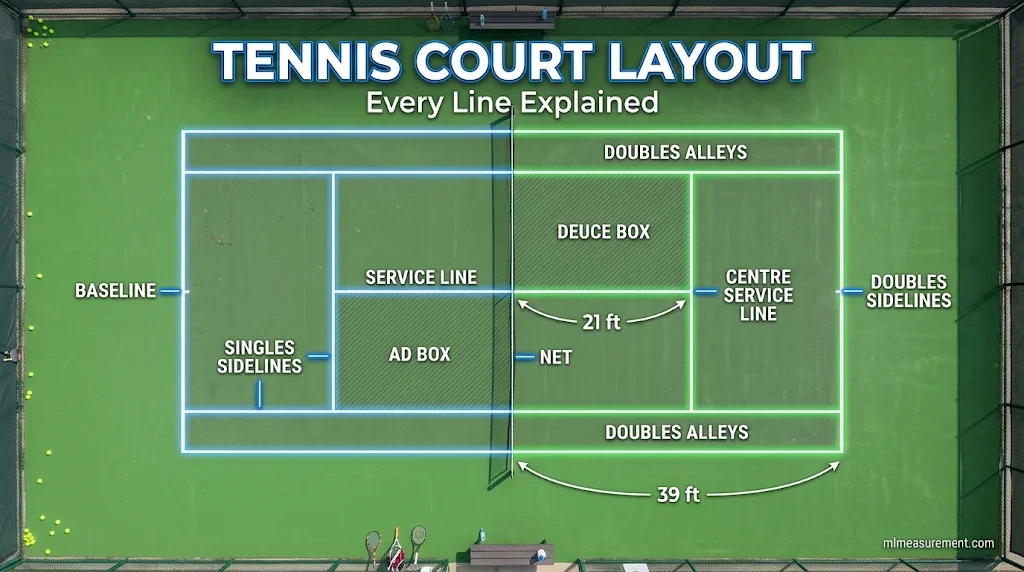
Every line has a job. Here is the tennis court layout from the net outward:
- Net: It sits at the centre of the court.
- Service line: It runs 21 ft (6.4 m) from the net on each side.
- Service boxes: The centre service line splits the area behind the net into the deuce box (right) and the ad box (left).
- Baseline: It marks the back of the court, 39 ft from the net.
- Sidelines: Inner lines mark singles and outer lines mark doubles.
The gap between the service line and the baseline is 18 feet deep. Players call it “no man’s land.” Balls land at your feet there, so most players avoid standing in it.
Just as accurate tennis court dimensions are essential for comfortable movement and proper play, the right measurements matter in every part of your home. When setting up a comfortable bedroom, understanding standard pillow sizes and dimensions can help you choose pillows that fit your bed and sleeping preferences perfectly.
What is the line width on a tennis court? According to MSF Sports, the centre service line and centre mark are 2 in (5 cm) wide. Other lines run 1 to 2 in, and the baseline can reach 4 in (10 cm).
Why is cross-court the safest shot? The diagonal runs about 82.5 feet, longer than the 78-foot straight line. The net is also lowest in the centre. UTR Sports makes this same point.
Net Height, Run-Off and Space Needed for a Tennis Court
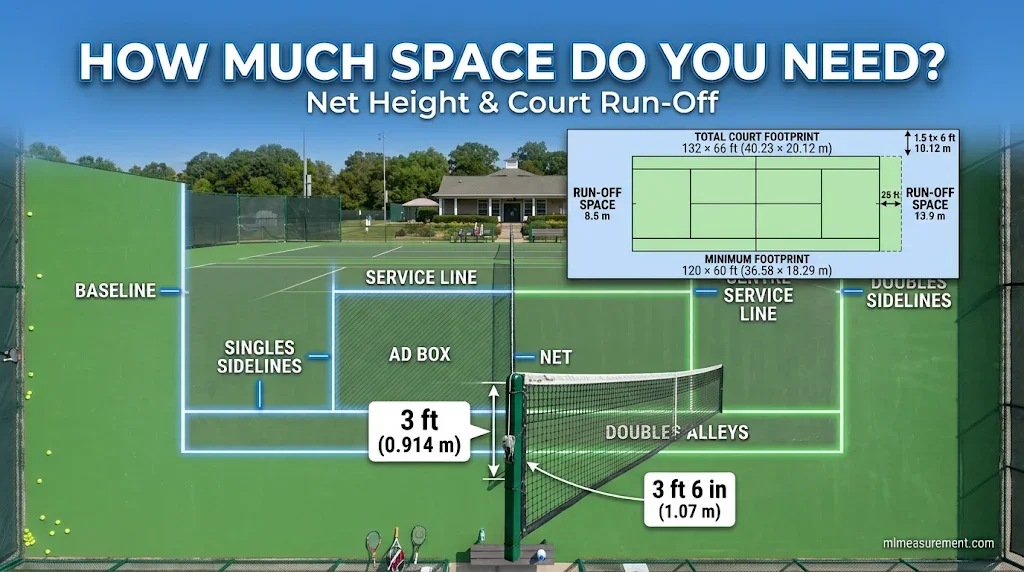
What is the tennis net height? The net is 3 ft 6 in (1.07 m) at the posts and 3 ft (0.914 m) at the centre. The posts stand 3 ft outside the court, per the ITF rules summary from ASICS.
The lines are only part of the footprint. Players also need run-off space. This is the room behind the baselines and beside the sidelines. MSF Sports lists these totals:
| Level | Total length | Total width |
|---|---|---|
| ITF recommended | 132 ft (40.2 m) | 66 ft (20.1 m) |
| ITF minimum | 120 ft (36.6 m) | 60 ft (18.3 m) |
| Recreational minimum | 114 ft (34.8 m) | 56 ft (17.1 m) |
The ITF minimum of 120 x 60 ft gives 7,200 sq ft. That is the answer for most backyard tennis court size questions. Allow extra room for fences and benches.
Which way should a tennis court face? Build it north to south. The sun then crosses the sidelines and stays out of players’ eyes. The USTA and Tennis Canada both prefer this layout. Measure against true north, not magnetic north.
How tall must an indoor tennis court be? Playtomic lists a minimum ceiling of 29.5 ft (9 m). That clearance is measured above the net.
Junior, Padel and Pickleball Court Size Comparison
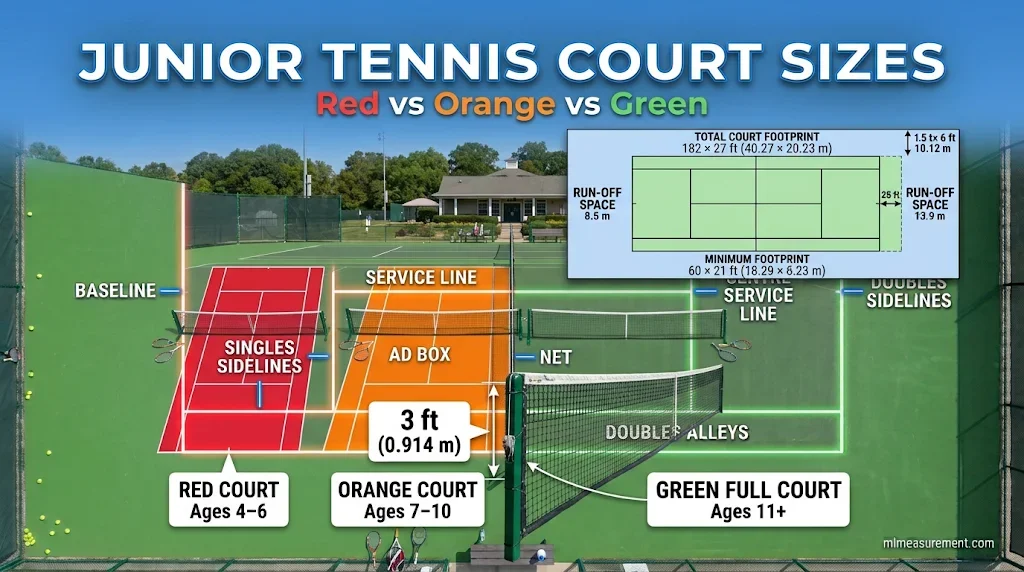
Kids start on smaller courts. The USTA’s 10 and Under Tennis program follows this ladder, as ASICS and UTR Sports describe it:
- Red court (ages 4-6): 36 x 18 ft, net 2 ft 9 in.
- Orange court (ages 7-10): 60 x 21 ft, net 3 ft.
- Green court: the full 78 x 27 ft court, with a slower ball.
- Ages 11 and up: the adult court.
Here is how the three racket-sport courts compare:
| Court | Size | Notes |
|---|---|---|
| Tennis (doubles) | 78 x 36 ft | Open court |
| Padel | 66 x 33 ft (20 x 10 m) | Enclosed by glass and mesh walls |
| Pickleball | 44 x 20 ft | Four fit in one tennis court |
Padel figures are from Playtomic. The pickleball count is from UTR Sports. Many clubs now convert tennis courts for these sports.
FAQs
What is the standard size of a tennis court?
A standard tennis court is 78 ft long. It is 27 ft wide for singles and 36 ft wide for doubles. The service line sits 21 ft from the net. With run-off, the full space is at least 120 x 60 ft.
What is the 80/20 rule in tennis?
The term has no single official meaning. In doubles, it describes your recovery position. About 80% of the time you hold your ground or move forward, and 20% of the time you move back. This is how Active Away explains it.
How much space do you need to make a tennis court?
You need at least 7,200 sq ft (120 x 60 ft) for one court with run-off. The ITF recommends 132 x 66 ft (8,712 sq ft) for top-level play. Plan for a north-south layout and proper drainage.
How many padel courts fit on a tennis court?
Two to three. Wikipedia states that padel courts can typically fit within the area of a tennis court. Shelter Structures says three fit comfortably, while Sports Venue Calculator puts it at two. The real count depends on your run-off, wall design and site shape.
Conclusion
You now have the key numbers: 78 ft long, 27 ft wide for singles, 36 ft wide for doubles, and 120 x 60 ft of space. Check the latest ITF and USTA rules before you build or paint a court.

Rehmaan Khan is a Measurement Content Researcher Specializing in MLmeasurement, Size Guides, Charts, and Simple Educational Measurement Content.