
You weigh 75 kg, or about 165 lbs. You want to get lean. This guide shows what that number means and how to burn stubborn fat with a plan that works.
Short answer: 75 kg to fit is a body-composition goal, not a weight goal. You lose fat, keep muscle, and let the scale follow.
Table of Contents
What Is 75 kg in Weight?
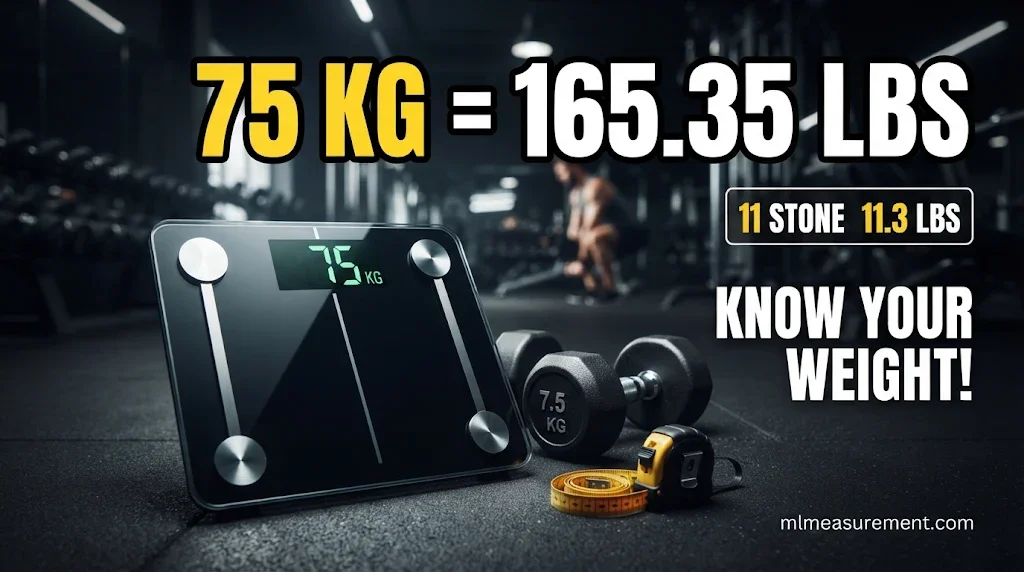
75 kg equals 165.35 pounds. That is 165 lb 5.5 oz, per the Inch Calculator.
The kg to lbs formula is simple. Multiply kilograms by 2.20462. Many sites round it to 2.205, which gives 165.375. Cuemath uses this rounded factor. That is why you may see two slightly different answers.
What is 75 kg in stone and pounds? It is about 11 st 11.3 lb, or roughly 11.8 stone, per RapidTables. One stone equals 14 pounds.
Here is a quick mental trick. Double the kilograms, then add 10%. So 75 × 2 = 150, plus 15, gives 165 lbs.
Strictly, kilograms measure mass, not weight. A 75 kg person weighs about 735 Newtons on Earth, using 9.81 m/s² for gravity, per Answers. In daily life, people say “weight” anyway.
| Kilograms | Pounds |
|---|---|
| 65 kg | 143.3 lb |
| 70 kg | 154.3 lb |
| 75 kg | 165.3 lb |
| 80 kg | 176.4 lb |
| 85 kg | 187.4 lb |
Is 75 kg a Good Weight?

It depends on your height. Weight alone cannot answer this.
Losing stubborn fat while maintaining muscle requires consistent strength training, especially compound exercises that build multiple muscle groups. Adding heavy barbell squats to your workout routine can help develop stronger legs, improve lower-body power, and support your journey toward a leaner, fitter physique.
The CDC sorts adult BMI into four ranges: below 18.5 is underweight, 18.5 to 24.9 is healthy, 25 to 29.9 is overweight, and 30 or more is obese. Here is where 75 kg lands by height (BMI calculated from the CDC formula):
- 5’4″ → BMI about 28.4 (overweight range)
- 5’9″ → BMI about 24.4 (healthy range)
- 6’0″ → BMI about 22.4 (healthy range)
The CDC lists 125 to 168 lbs as the healthy range at 5’9″. At 165 lbs, you sit near the top of it.
BMI has limits. It does not measure body fat directly, and two people with the same BMI can carry different amounts of fat. Athletes can show a high BMI because of muscle. So also track your waist size and body fat percentage.
How Does 75 kg Look on Your Body?

75 kg looks different on everyone. Height, muscle and fat decide the look.
A 6’0″ person at 75 kg often looks slim and athletic. A 5’4″ person at the same weight may carry visible belly fat. Muscle is denser than fat, so a lean person at 75 kg looks smaller than a soft one.
This is the “skinny-fat” trap. The scale says normal, but the body looks soft. The fix is not less food alone. It is more muscle and less fat, which is exactly what 75 kg to fit means.
The 75 kg Fat-Loss Blueprint to Get Fit

Most competitor pages stop at the conversion. This is the part they skip. Use these steps to shred stubborn fat.
Set a small calorie deficit. One pound of fat holds about 3,500 calories. Health.gov suggests eating 500 to 750 fewer calories a day to lose weight. Crash diets backfire. The CDC says slow, steady loss of about 1 to 2 pounds a week helps people keep weight off.
Eat enough protein. Protein protects muscle while you cut. A 2018 meta-analysis in the British Journal of Sports Medicine found gains level off near 1.6 g per kg per day. For 75 kg, that is about 120 g. Good picks are eggs, chicken, Greek yogurt, tuna and beans.
Lift weights 3 to 4 days a week. Strength training tells your body to keep muscle while it burns fat. Focus on squats, rows, presses and deadlifts. U.S. guidelines also call for muscle-strengthening work on at least two days a week.
Walk and do cardio. Aim for at least 150 minutes of moderate activity a week. A brisk walk counts. Daily steps burn calories without hurting recovery.
Fix sleep and stress. The CDC lists sleep and stress management as part of healthy weight. Poor sleep raises hunger. High stress often leads to snacking. Alcohol adds empty calories too.
Skip the spot-reduction myth. Crunches do not burn belly fat. Fat leaves the whole body, and the belly often goes last. Be patient with it.
Track the right numbers. Check your waist once a week. Take photos every two weeks. Watch the weekly weight trend, not the daily swing.
How long does it take? At 1 to 2 lbs a week, losing 10 lbs takes about 5 to 10 weeks. Even a small loss pays off. The CDC notes that a 5% drop can improve blood pressure, cholesterol and blood sugar. For you, 5% is about 8 lbs.
FAQs
What is 75 kg in weight?
75 kg equals 165.35 pounds (165 lb 5.5 oz). To convert, multiply kilograms by 2.20462.
Is 75 kg a good weight?
It can be. At 5’9″ and 165 lbs, you fall in the CDC’s healthy BMI range. At 5’4″, the same weight reads as overweight. Height and body fat matter most.
How does 75 kg look like?
It depends on height and muscle. At 6’0″, 75 kg looks lean. At 5’4″, it looks fuller. Lean mass makes you look smaller than fat does at the same weight.
What is 75 kg in stone and pounds?
75 kg equals about 11 stone 11.3 pounds, or 11.8 stone.
Conclusion
75 kg is 165.35 lbs. Whether that is fit depends on your height, muscle and body fat. Eat a small deficit, lift weights, walk daily and sleep well. Do that, and the stubborn fat will come off.

Rehmaan Khan is a Measurement Content Researcher Specializing in MLmeasurement, Size Guides, Charts, and Simple Educational Measurement Content.