
1 kilometer long sounds simple on paper — but most people struggle to picture it without a map or a mile marker. This guide fixes that with real, everyday examples you already know.
Quick answer: 1 kilometer equals about 0.62 miles, or roughly 3,280 feet. Below, you’ll find eight things that are about 1 kilometer long, plus fast answers to the most-searched questions on this topic.
Table of Contents
How Much Distance Is 1 km?
1 kilometer equals 1,000 meters, or about 0.62 miles. The kilometre (spelled kilometer in American English) is the standard unit for measuring land distance almost everywhere in the world — the United States, United Kingdom, and Liberia are the main exceptions, still relying on the statute mile (Wikipedia: Kilometre).
Britannica defines it plainly: a kilometre (km) is a unit of length equal to 1,000 metres, equivalent to 0.6214 mile (Britannica).
Here’s a quick reference table:
| Kilometers | Miles | Feet | Yards |
|---|---|---|---|
| 1 km | 0.62 mi | 3,280.8 ft | 1,093.6 yd |
Is 1 km longer than 1 mile? No. A mile is longer than a kilometer. One mile equals 1.61 kilometers, meaning you’d need to walk 1 km and then some to match a full mile (Study.com).
Is 100 Metres 1 km? (Clearing Up the Confusion)
No — 100 metres is not 1 km. This is one of the most common mix-ups in measurement, and it’s an easy one to clear up.
1 kilometer equals 1,000 meters — ten times longer than 100 meters. Think of it this way: if you ran a 100-meter dash ten times in a row, you’d cover exactly 1 kilometer.
A standard running track offers an even clearer picture. Most tracks measure 400 meters per lap, so completing 2.5 laps equals 1 full kilometer (Study.com). That’s a handy mental shortcut for runners, students, and anyone estimating distance at a local track.
8 Real-Life Things That Are About 1 Kilometer Long
Each of these familiar places and objects measures close to 1 kilometer, giving you a concrete, real-world reference instead of an abstract number.
10 Football Fields Lined Up
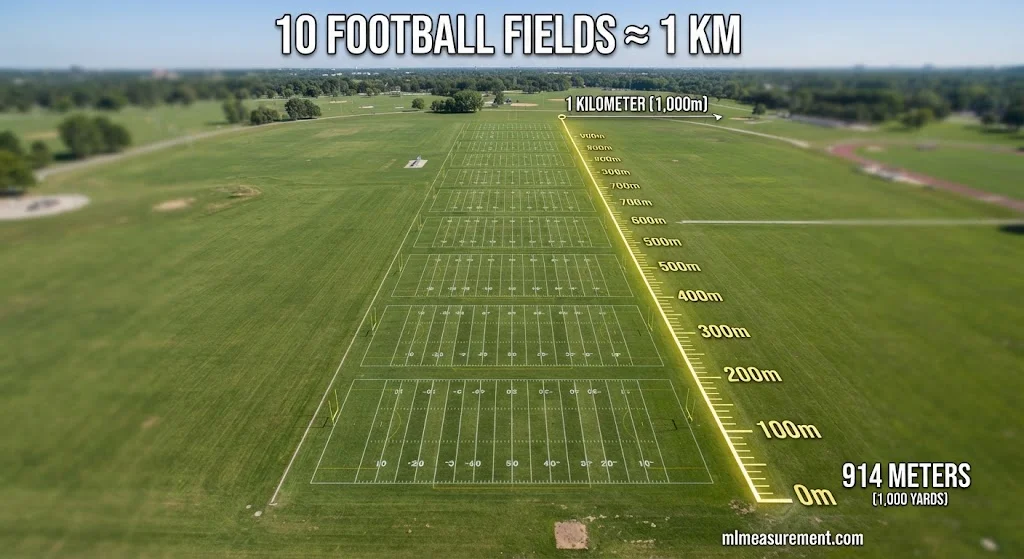
A regulation American football field measures 100 yards (91.4 meters) from goal line to goal line. Line up ten of them end to end, and you’ve covered 914 meters — just shy of a full kilometer.
The Golden Gate Bridge’s Main Span

San Francisco’s Golden Gate Bridge has a main suspension span measuring 1,280 meters (4,200 feet) — just over 1 kilometer. At the time of its 1937 completion, it held the record for the longest suspension span in the world.
A 10-to-12-Minute Walk at Average Pace
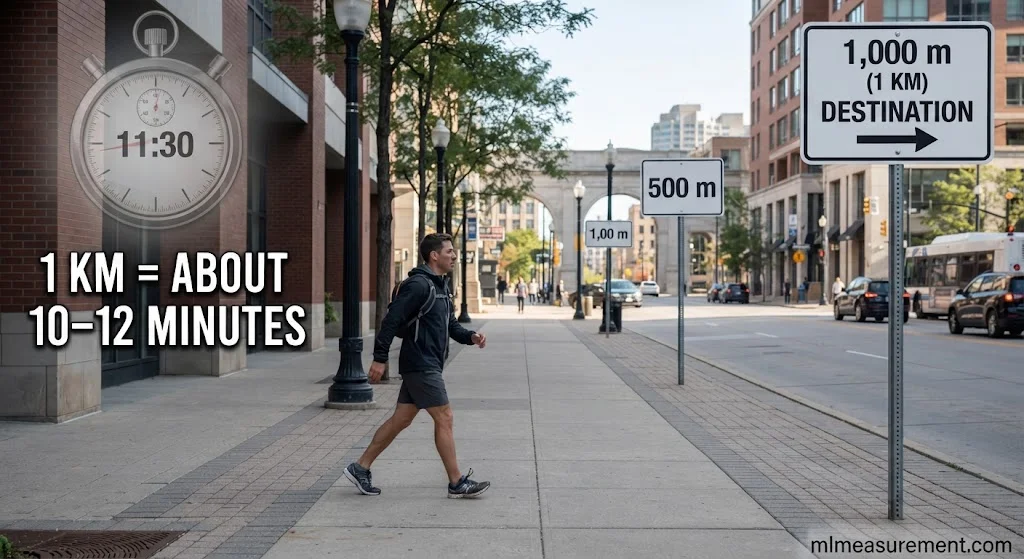
Most healthy adults walk at roughly 5 km/h (3.1 mph). At that pace, covering 1 kilometer takes about 12 minutes. A brisk walker moving at 6 km/h can shave that down closer to 10 minutes, while a slower, leisurely stroll at 4 km/h stretches it to about 15 minutes.
Central Park’s Width (East to West)
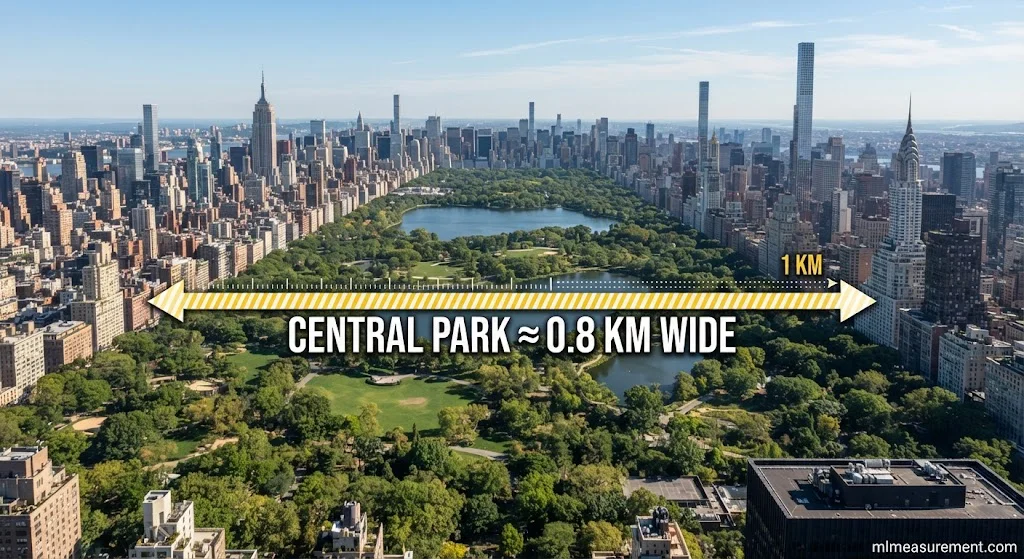
New York’s Central Park spans about 0.5 miles (roughly 800 meters) from east to west — close to a full kilometer. Walking that width takes most visitors around 10 to 15 minutes, a useful gut-check for the distance.
Must visit: 30 Meters Long: 9 Real-Life Things That Are About 30 Meters Long
2.5 Laps Around a Running Track
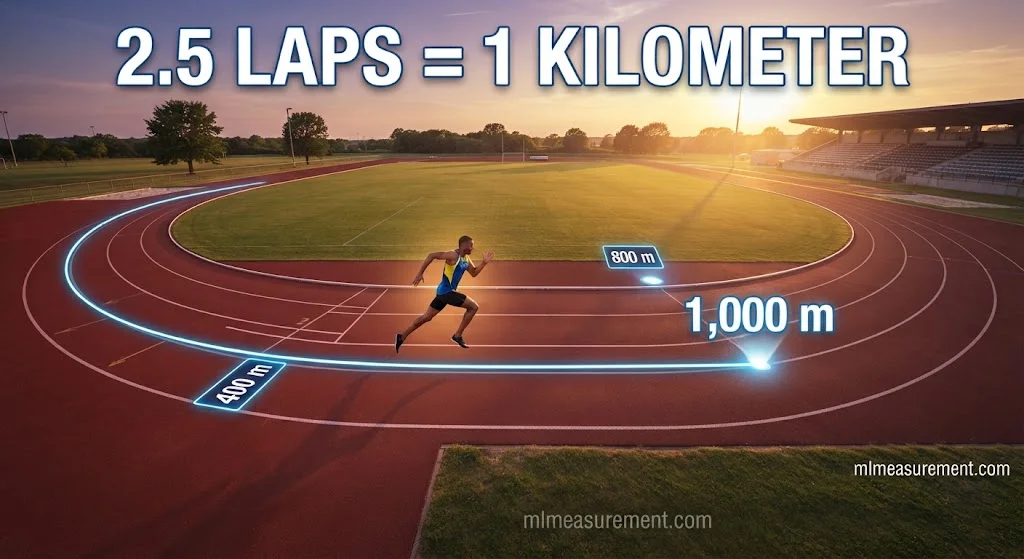
Standard outdoor running tracks measure 400 meters per lap. Complete two and a half laps, and you’ve run exactly 1 kilometer — a benchmark used constantly in training plans and school fitness tests.
Ten City Blocks in a Row
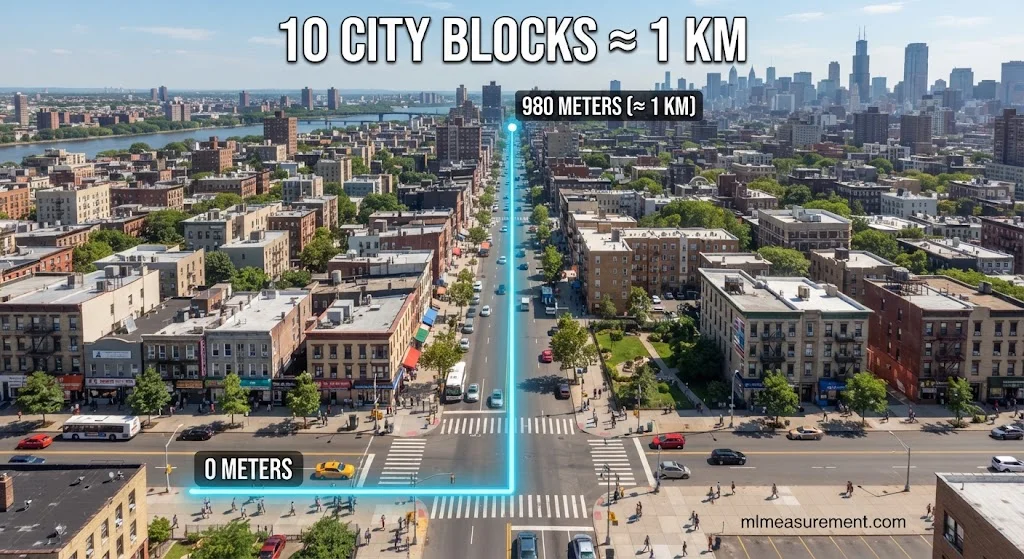
In a typical American city grid, a standard block runs roughly 80 to 100 meters. Walk ten blocks consecutively, and you’ll have covered close to 1 kilometer — a distance many commuters cross without thinking twice.
The Brooklyn Bridge’s Main Span, Doubled
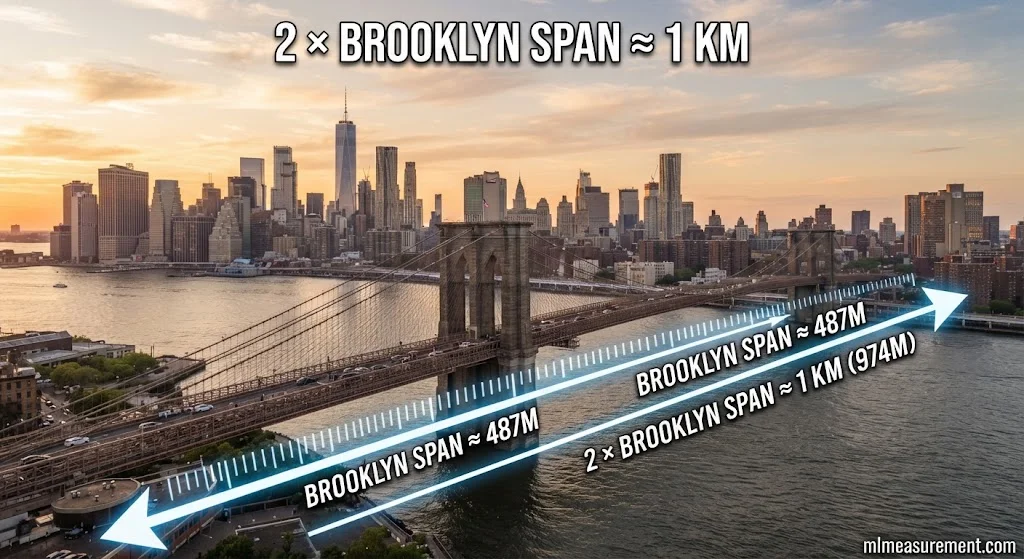
The Brooklyn Bridge’s main span measures 487 meters (1,600 feet). Picture that span twice over, back to back, and you land right around 1 kilometer — a useful way to grasp this iconic structure’s scale.
The Earth’s Curvature Reference Point
While not a physical object, 1 kilometer was historically defined as one ten-millionth of the distance from the North Pole to the Equator, following the metre’s original 1793 definition by the French Academy of Sciences (Wikipedia: Kilometre). The Earth’s total circumference measures roughly 40,000 kilometers — a fact that traces directly back to how the metric system itself was built.
How Long Is a 1 km Walk?
A 1 km walk takes most people between 10 and 15 minutes, depending on pace, fitness level, and terrain.
Here’s a simple breakdown by walking speed:
- Leisurely pace (3–4 km/h): 15–20 minutes
- Average pace (5 km/h): about 12 minutes
- Brisk pace (6 km/h): 10 minutes
- Fast pace or light jog (7+ km/h): under 10 minutes
Terrain matters too. A flat sidewalk moves faster than an uphill trail, and factors like age, fitness, and even weather can shift these numbers slightly in either direction.
FAQs
How much distance is 1 km?
1 kilometer equals 1,000 meters, or about 0.62 miles (3,280.8 feet).
How long is a 1 km walk?
Most people cover 1 kilometer in 10 to 15 minutes, walking at an average pace of 4 to 6 km/h.
Is 100 metres 1 km?
No. 1 kilometer equals 1,000 meters — ten times the distance of 100 meters.
Is 1 km longer than 1 mile?
No. A mile is longer. One mile equals 1.61 kilometers, so 1 km falls short of a full mile.
Conclusion
1 kilometer long breaks down to 0.62 miles, or about a 10-to-15-minute walk for most people. Once you connect it to things like ten football fields, the Golden Gate Bridge’s main span, or 2.5 laps around a track, the distance stops feeling abstract and starts making practical sense.

Rehmaan Khan is a Measurement Content Researcher Specializing in MLmeasurement, Size Guides, Charts, and Simple Educational Measurement Content.