
Most people asking this question are standing in a pharmacy that how many units in an insulin syringe, holding a syringe, and realizing their prescription says “units” while the barrel says “mL.” That gap causes real dosing errors every single day across the United States.
1 mL is equal to 100 units in a standard U100 insulin syringe. This is the national standard used for human insulin, analog insulin, and compounded GLP-1 medications like semaglutide and tirzepatide. Know this number. It is the foundation of every safe injection.
How Many Units in an Insulin Syringe
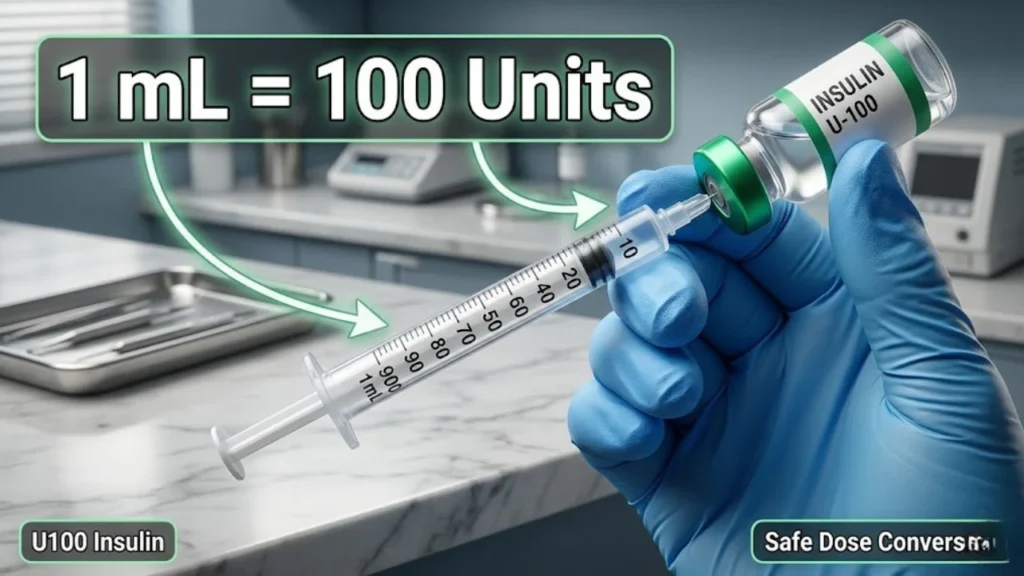
On any U100 insulin syringe, the math is fixed and simple. Every 1 mL of liquid contains exactly 100 insulin units. This is not brand-specific. It applies to insulin glargine (Lantus), insulin aspart (NovoLog), insulin lispro (Humalog), and all other U100 formulations sold in the USA.
The core conversion every patient must know:
| Units | Volume in mL | Volume in CC |
|---|---|---|
| 10 units | 0.10 mL | 0.10 CC |
| 20 units | 0.20 mL | 0.20 CC |
| 30 units | 0.30 mL | 0.30 CC |
| 50 units | 0.50 mL | 0.50 CC |
| 75 units | 0.75 mL | 0.75 CC |
| 100 units | 1.00 mL | 1.00 CC |
One thing most articles overlook: mL and CC are the exact same unit of volume. 1 CC equals 1 mL with no conversion needed. If your syringe barrel is labeled in CC and your prescription is written in mL, you are reading the identical measurement under two different names.
Why does this standard exist? The FDA standardized U100 insulin across the United States specifically to eliminate the dangerous confusion that came from older concentrations like U40 and U80 being used interchangeably. Standardization saves lives.
Must Visit: How Many Milliliters Are in a Litre? Complete Conversion Guide 2026
U100, U40, and U500 Insulin — Does the Concentration Change Units Per mL?
Yes, and this is where the most serious dosing mistakes occur. The “U” number in insulin names directly tells you how many units are packed into every 1 mL of that liquid.
Insulin concentration comparison:
| Insulin Type | Units Per 1 mL | Where It Is Used |
|---|---|---|
| U100 | 100 units | Standard USA human and analog insulin |
| U40 | 40 units | Veterinary insulin for pets, some international markets |
| U500 | 500 units | Severe insulin resistance patients only (Humulin R U-500) |
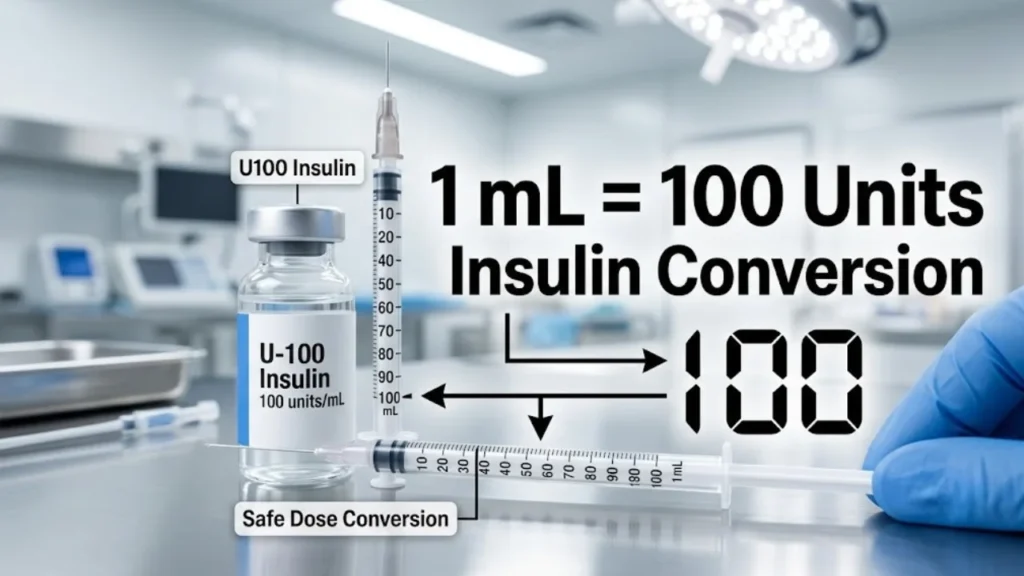
What happens if you use a U40 syringe with U100 insulin? You receive 2.5 times your intended dose. That is not a small error. It can trigger severe hypoglycemia, loss of consciousness, and hospitalization. The FDA has issued specific safety communications about this exact mismatch.
U500 insulin is five times more concentrated than U100. One mL of Humulin R U-500 holds 500 units, not 100. Patients prescribed U500 require either a dedicated U500 syringe or a precise conversion supervised by their endocrinologist or clinical pharmacist. Never estimate with U500.
The rule is non-negotiable: always match your syringe label to your insulin vial label before drawing every dose.
How to Read the Markings on a 1 mL Insulin Syringe
A 1 mL syringe holds a maximum of 100 units. Because it covers the full U100 range, most 1 mL syringes are marked in 2-unit increments per line. This is the most commonly misunderstood detail in syringe use, and competitors rarely explain it clearly.
Smaller syringes work differently. A 0.3 mL (30-unit) syringe has markings every 1 unit, and some versions mark every half-unit. That level of precision matters enormously for children or patients on micro-doses.
How to draw an accurate dose on a 1 mL syringe:
- Check the vial label first. Confirm it reads U100 and matches your syringe.
- Clean the rubber stopper on the vial with a fresh alcohol swab.
- Pull the plunger back to draw air equal to your target unit count.
- Insert the needle through the stopper, push in the air, then invert the vial.
- Draw insulin slowly until the top edge of the black rubber plunger tip aligns with your dose line.
- Hold the syringe at eye level. Reading from an angle creates a parallax error that shifts your visible measurement by 2 to 4 units.
- Tap the barrel gently to float any air bubbles upward, then push them out before injecting.
Reading from the wrong edge of the plunger is the single most common measurement error clinicians and pharmacists see in patients self-administering insulin. Always use the top edge, not the bottom.
1 mL vs 0.5 mL vs 0.3 mL Syringe — Which Size Is Right for Your Dose?
Syringe size directly affects how accurately you can read your dose. A smaller barrel spreads the same volume across more markings, giving you finer precision. The clinical guidance from diabetes educators is consistent: use the smallest syringe size that comfortably holds your full prescribed dose.
Syringe selection guide by dose range:
| Syringe Size | Max Capacity | Best Dose Range | Marking Precision |
|---|---|---|---|
| 0.3 mL | 30 units | 1 to 30 units | Every 1 unit or 0.5 unit |
| 0.5 mL | 50 units | 31 to 50 units | Every 1 unit |
| 1.0 mL | 100 units | 51 to 100 units | Every 2 units |
What most articles do not say: buy one syringe size above your current dose if your prescription is likely to increase. A patient taking 28 units today who purchases a 0.3 mL syringe will need to restock immediately if their physician adjusts the dose to 32 units next month. Planning one step ahead prevents a gap in treatment.
Needle gauge and length selection:
- Gauge (thickness): Ranges from 28G to 31G. Higher gauge number means a thinner, finer needle. A 31G needle delivers the most comfortable daily subcutaneous injection for most adults.
- Length: Options run from 4 mm to 12.7 mm. Clinical evidence and the American Diabetes Association Standards of Care support 4 mm or 6 mm needles for most adults, reaching the subcutaneous fat layer without penetrating muscle.
Rotate your injection sites across the abdomen (2 inches from the navel), front of the thighs, and back of the upper arms. Repeating the same spot causes lipohypertrophy, a hardening of fatty tissue under the skin that slows insulin absorption and makes blood sugar control unpredictable. The ADA reports this condition affects a significant portion of long-term insulin users in the USA.
FAQs
Is a shot 25 or 50 mL?
A standard US shot of alcohol is neither 25 mL nor 50 mL. In the United States, one standard shot equals 1.5 fluid ounces, which is approximately 44 mL. The 25 mL and 50 mL measures are more common in European bartending standards, not American ones. This question often arises when people confuse beverage measurement with medical syringe volume, which are entirely separate systems with no overlap.
What is 1 shot in mL?
In the United States, 1 shot equals roughly 44 mL (1.5 oz). Some bars pour a 30 mL (1 oz) short pour, and others go as high as 59 mL (2 oz). There is no federal legal standard for shot size in the USA, unlike the UK. In a medical context, a “shot” simply means one injection, and the volume is determined entirely by the prescribed dose, not a fixed amount.
Is a shot glass 50 mL?
A standard US shot glass holds approximately 44 mL, not 50 mL. However, many novelty and oversized shot glasses sold in the United States do hold exactly 50 mL (about 1.7 oz). The 50 mL volume is more precisely aligned with UK and European single-serve standards than with American ones. Always check the glass capacity if precision matters.
Is 50 mL a double shot in the UK?
Yes. In the United Kingdom, a single spirit measure is legally defined as 25 mL, making a double exactly 50 mL. This is enforced under the Weights and Measures Act 1985, which regulates alcohol serving sizes in licensed premises. This is why ordering a “double” in a UK pub delivers a precise, legally guaranteed 50 mL, while the same order in the USA may vary by establishment.
Conclusion
1 mL equals 100 units on every standard U100 insulin syringe sold in the United States. That single fact, memorized and applied consistently, prevents the most common and dangerous self-injection errors.
Three rules that must never be skipped: match your syringe to your insulin concentration every time, choose the smallest barrel that holds your full dose, and read from the correct plunger edge at eye level. According to a 2022 analysis published in Diabetes Care, insulin dosing errors remain among the most frequent preventable medication mistakes in US outpatient settings.
Now your confusion must be clear that How Many Units in an Insulin Syringe after reading this blog post.

Rehmaan Khan is a Measurement Content Researcher Specializing in MLmeasurement, Size Guides, Charts, and Simple Educational Measurement Content.