
How many milliliters are in a litre? The answer is simple. There are exactly 1,000 milliliters (mL) in 1 litre (L). This is one of the most useful metric unit conversions you will ever learn.
Whether you are measuring water for a recipe, tracking your daily fluid intake, or doing a science experiment, knowing this single conversion makes everything easier. This guide covers the full picture — formulas, tables, real-life examples, and everything the basic guides leave out.
How Many mL Are in a Litre? (Quick Answer)
1 litre = 1,000 millilitres.
Both millilitres and litres are units of liquid volume in the International System of Units (SI). The litre is the base unit of capacity for measuring liquids. The millilitre is a smaller unit — one thousandth of a litre.
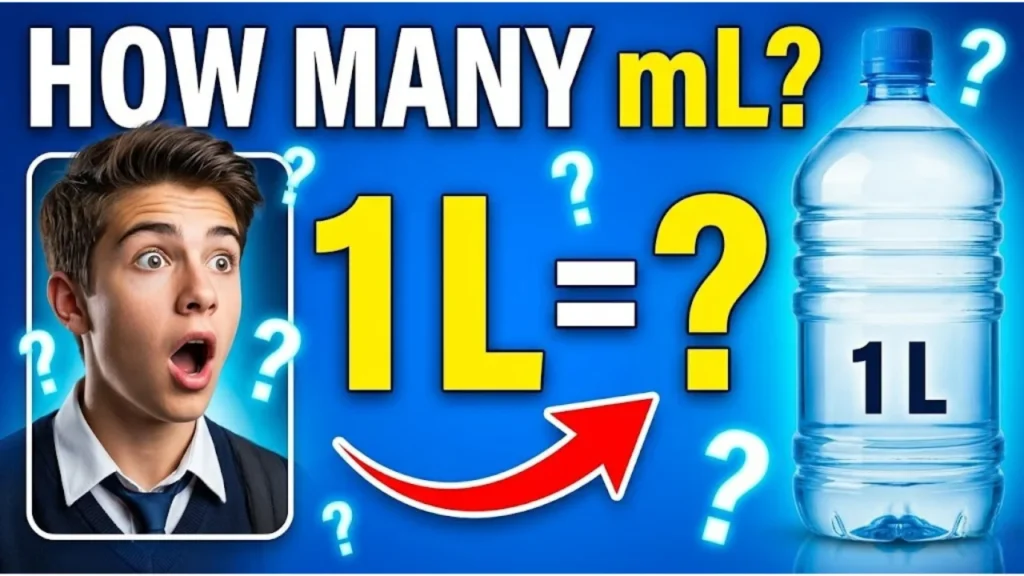
The metric system works on a base-10 structure. That means every unit is 10 times larger or smaller than the next. So converting between mL and L is just a matter of multiplying or dividing by 1,000.
The litre is used worldwide as the standard measure for beverages, fuel, and liquid products. According to the National Institute of Standards and Technology (NIST), the metric system is the globally accepted standard for measurement.
How Many Milliliters Are in a Litre? Complete Conversion Guide 2026 is available in this blog.
Milliliters to Litres Conversion Formula
The conversion formula is straightforward.
To convert litres to millilitres: multiply by 1,000 L × 1,000 = mL
To convert millilitres to litres: divide by 1,000 mL ÷ 1,000 = L
These two formulas cover every situation you will face. Here are solved examples to make it clear.
Q1: Convert 2.5 litres to millilitres. 2.5 × 1,000 = 2,500 mL
Q2: Convert 3,500 mL to litres. 3,500 ÷ 1,000 = 3.5 L
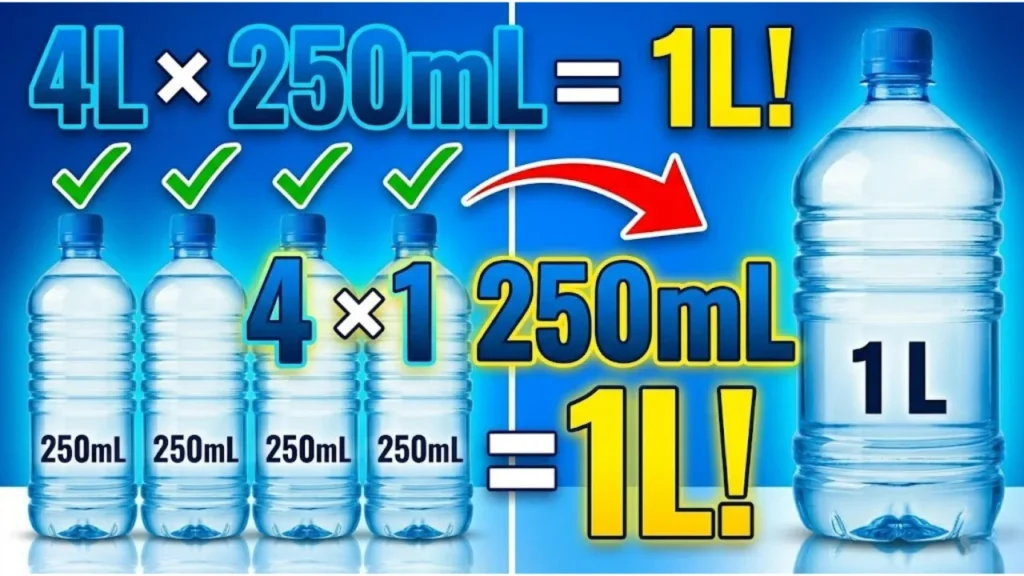
Q3: How many 250 mL are in 1 litre? 1,000 ÷ 250 = 4 portions of 250 mL
Q4: How many 500 mL are in 1 litre? 1,000 ÷ 500 = 2 portions of 500 mL
Q5: Convert 0.15 L to millilitres. 0.15 × 1,000 = 150 mL
These examples follow the same approach used by trusted educational platforms like BYJU’S and Khan Academy to teach metric capacity conversion step by step.
Must Visit: How Many mL in an Oz?
Litres to Millilitres Conversion Table
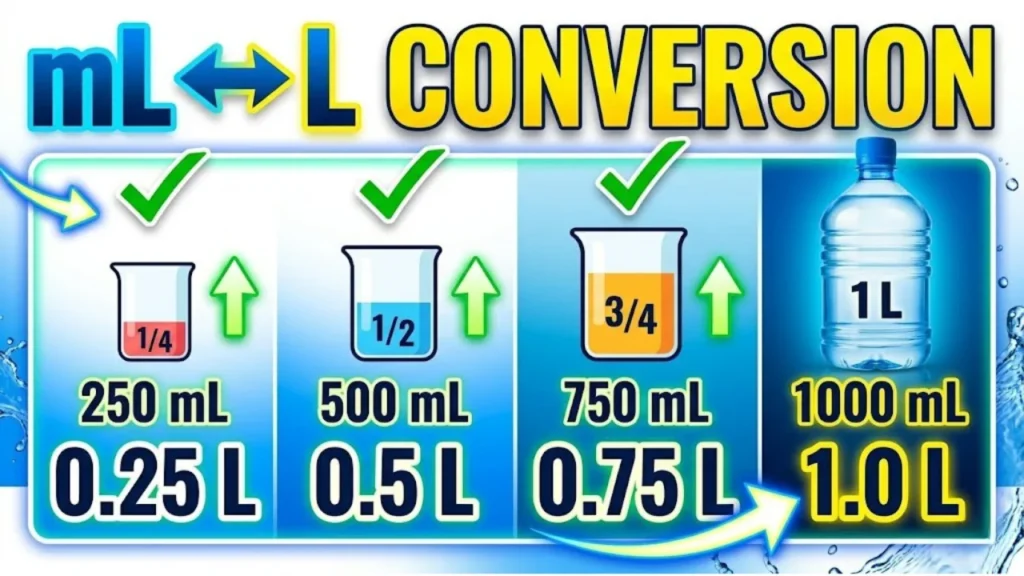
A quick reference table saves time. Use this whenever you need a fast answer.
Litres to Millilitres
[copy]
1 L = 1,000 mL
2 L = 2,000 mL
3 L = 3,000 mL
4 L = 4,000 mL
5 L = 5,000 mL
6 L = 6,000 mL
7 L = 7,000 mL
8 L = 8,000 mL
9 L = 9,000 mL
10 L = 10,000 mL
15 L = 15,000 mL
20 L = 20,000 mL
25 L = 25,000 mL
30 L = 30,000 mL
50 L = 50,000 mL
100 L = 100,000 mL
[/copy]
Litres to Millilitres
[copy]
1 mL = 0.001 L
10 mL = 0.01 L
50 mL = 0.05 L
100 mL = 0.1 L
250 mL = 0.25 L
500 mL = 0.5 L
750 mL = 0.75 L
1,000 mL = 1 L
[/copy]
No competitor covers both directions in one place. This dual table gives you a complete volume conversion reference for any situation.
How Many Milliliters Are in a Litre? Real-Life Examples
Understanding mL to litre conversion becomes much easier when you see it in real life. Here are the most common situations where this matters.
Cooking and Baking
Most American recipes use cups and ounces, but many imported recipes and food labels use millilitres and litres. If a recipe calls for 0.5 L of broth, that is 500 mL. Knowing this helps you measure accurately without guessing. According to AllRecipes, precise liquid measurement is one of the top factors in consistent cooking results.
Daily Water Intake
Health experts commonly recommend drinking 2 litres of water per day. That equals 2,000 mL. Tracking your intake in mL helps you hit that goal more precisely — especially when using water bottles that show mL markings.
The U.S. National Academies of Sciences recommends a daily fluid intake of around 3.7 litres (3,700 mL) for men and 2.7 litres (2,700 mL) for women, including water from food sources.
Liquid Medicine
Doctors and pharmacists measure liquid medication dosages in millilitres. A common children’s dose might be 5 mL or 10 mL. Knowing that 30 mL equals 0.03 L helps you understand how small these amounts are in the broader capacity scale. The Mayo Clinic confirms that accurate mL measurement is critical for safe medication use.
Science Experiments
In labs and school science projects, precise liquid volume measurement is essential. Scientists use graduated cylinders and measuring beakers marked in mL. A standard lab beaker holds 250 mL — exactly one quarter of a litre. Resources like Science Buddies and National Geographic Kids use mL and L as the foundation of all liquid science activities.
Fuel and Automotive
In everyday American life, fuel is measured in gallons. But in engineering and manufacturing, fluid volumes are often expressed in litres and millilitres. One US gallon equals approximately 3,785 mL, which is close to 3.785 litres.
Millilitres vs Litres — Other Metric Units of Liquid Volume
Most guides only talk about mL and L. But the metric system for liquid capacity includes several other units. Knowing where mL and L sit in this scale gives you a fuller picture.
Here is how the full metric capacity scale works, from smallest to largest:
[copy]
1 millilitre (mL) = 0.001 L
10 mL = 1 centilitre (cL)
100 mL = 1 decilitre (dL)
1,000 mL = 1 litre (L)
1,000 L = 1 kilolitre (kL)
[/copy]
Centilitres (cL) are commonly used in European wine and spirits measurements. A standard wine pour in a restaurant is often listed as 15 cL, which equals 150 mL.
Decilitres (dL) appear in medical lab reports, especially in blood test results. You may see a cholesterol reading expressed as mg/dL — milligrams per decilitre.
Kilolitres (kL) are used for large-scale water storage and industrial liquid volumes. One kilolitre equals 1,000 litres or 1,000,000 mL.
This broader context is something none of the competing guides cover. Understanding the full metric liquid measurement scale makes you more confident across all conversion scenarios.
FAQs
How many 500 mL are in 1 litre?
There are 2 portions of 500 mL in 1 litre. Since 1 litre equals 1,000 mL, dividing 1,000 by 500 gives you 2. Think of two standard 500 mL water bottles filling one full litre.
How many mL is 1 liter?
1 liter equals 1,000 mL. This is the core metric conversion fact. The litre is the standard unit of liquid volume in the SI system, and the millilitre is one thousandth of that.
Is 1 liter the same as 750 mL?
No. 1 litre is not the same as 750 mL. One litre equals 1,000 mL. A 750 mL bottle — like a standard wine bottle — holds only three quarters of a litre, not a full litre.
Is 250 mL equal to 1 liter?
No. 250 mL is one quarter of a litre, not a full litre. You would need four 250 mL portions to make up 1,000 mL, which equals exactly 1 litre.
Conclusion
1 litre always equals 1,000 millilitres. Multiply litres by 1,000 to get mL. Divide mL by 1,000 to get litres. That is the entire conversion in two steps.
From cooking and hydration to medicine and science, this single fact applies everywhere. Now you have the formula, the tables, the real-life context, and the full metric scale — everything you need to convert with complete confidence.

Rehmaan Khan is a Measurement Content Researcher Specializing in MLmeasurement, Size Guides, Charts, and Simple Educational Measurement Content.