
A regulation pickleball court is 20 feet wide and 44 feet long (6.1 m × 13.41 m). That is 880 square feet of playing space. You need about 30′ × 60′ of total space to play safely.
This guide covers the pickleball court size, the lines, the net, the space around the court, the surface, and the cost. Read on if you plan to build a backyard court, convert a tennis court, or just learn the layout.
Table of Contents
Pickleball Court Dimensions and Size (Official)
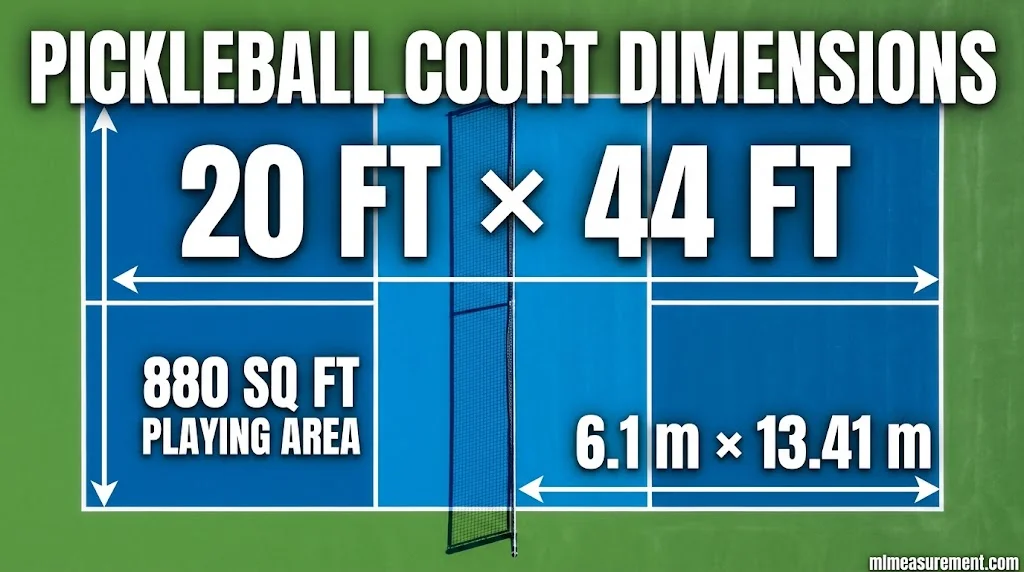
How big is a pickleball court? The playing area is 20′ × 44′ for both singles and doubles. This is the same size as a doubles badminton court. It is also about 31% of a doubles tennis court (36′ × 78′).
Here are the dimensions of a pickleball court at a glance, based on USA Pickleball specs and Dimensions.com:
| Feature | Imperial | Metric |
|---|---|---|
| Playing court | 20′ × 44′ | 6.1 m × 13.41 m |
| Playing area | 880 sq ft | 81.8 m² |
| Total space (minimum) | 30′ × 60′ | 9.14 m × 18.29 m |
| Total space (preferred) | 34′ × 64′ | 10.36 m × 19.51 m |
| Non-volley zone (Kitchen) | 7′ from the net | 2.13 m |
| Service area (each) | 10′ × 15′ | 3.05 m × 4.57 m |
| Net height | 36″ posts, 34″ center | 91.5 cm, 86.4 cm |
| Line width | 2″ | 5.08 cm |
Tip: the court is the same indoors and outdoors. Only the surface, lighting, and ball type change.
Pickleball Court Layout, Lines and Net Height
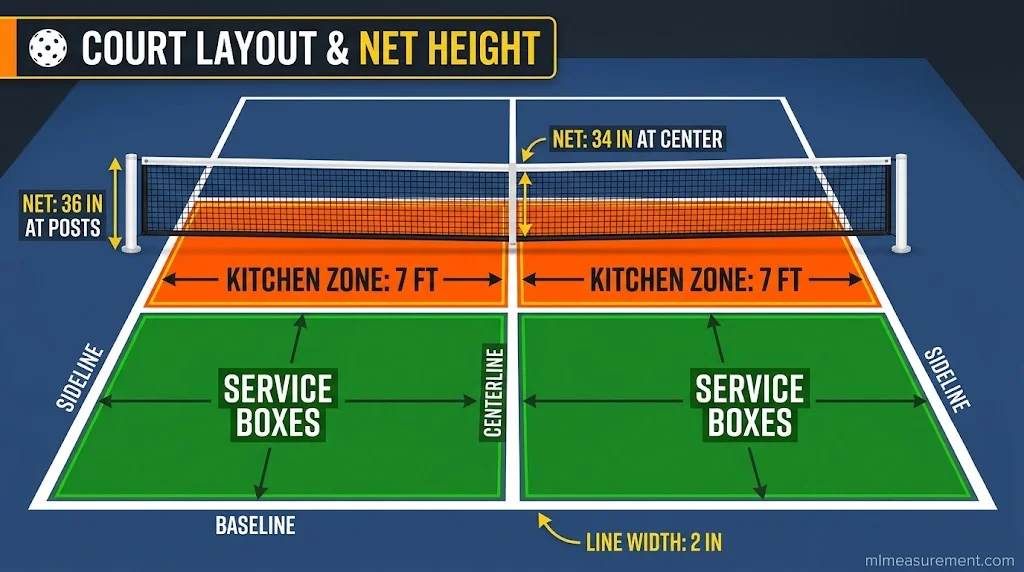
The pickleball court layout has five key parts. Each one has a job.
When planning a pickleball court, accurate measurements help you make the most of your available space. Similarly, choosing the right queen mattress size and dimensions ensures a comfortable fit for your bedroom without wasting valuable floor space.
- Baselines run along the back of each side.
- Sidelines run the full 44-foot length.
- Centerline splits the service areas, from the Kitchen line to the baseline.
- Non-volley zone (NVZ) line sits 7 feet from the net on each side.
- Service areas are two 10′ × 15′ boxes on each side of the net.
What is the Kitchen in pickleball? It is the non-volley zone, a 20′ × 7′ strip next to the net. You cannot hit a volley while you stand in it or touch its line.
How high is a pickleball net? The net is 36 inches at the posts and 34 inches at the center. It spans the full 20-foot width. Tight tension matters, because a sagging or high center changes the bounce and the play.
Builders often make these mistakes when marking lines:
- The NVZ line is not exactly 7 feet from the net.
- Lines are thicker than 2 inches.
- The center of the net sits above 34 inches.
Measure twice before you tape or paint. Use a snap line for straight edges.
Pickleball Court Space, Clearances and Tennis Court Fit

The 880 sq ft is only the playing area. How much space do you need for a pickleball court? Plan for 30′ × 60′ (1,800 sq ft) as a minimum. The preferred size is 34′ × 64′. This extra room, called run-off space, lets you chase lobs and wide shots without hitting a fence.
Dimensions.com lists a clearance of 5 feet on the sides and 8 feet at each end.
How many pickleball courts fit on a tennis court? A tennis court is 60′ × 120′. It fits four courts at 30′ × 60′ each. Three courts leave more room to move.
Other planning points:
- Space court sidelines 8 to 10 feet apart in a multi-court setup, per UTR Sports.
- Use 8 to 10 foot fencing. Taller fencing helps in windy places.
- Face outdoor courts north-south to reduce sun glare.
- Aim for 30 to 50 foot-candles of even light for night play.
- Use VersaCourt style tiles if you want a portable or multi-sport court.
Pickleball Court Surface, Cost and Driveway Setup
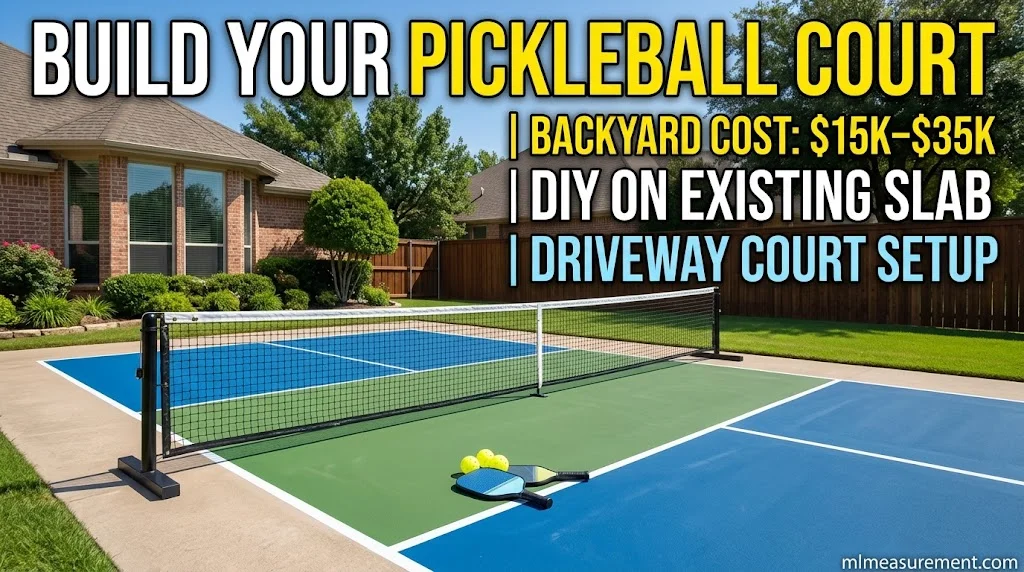
What is the best surface for a pickleball court? Concrete and asphalt are the standard outdoor choices. Acrylic coating adds grip and color. Indoor courts use hardwood, sport tile, or cushioned vinyl. Plan to recoat outdoor acrylic every 4 to 7 years.
How much does it cost to build a pickleball court? The range is wide. A 2026 guide from Bounce puts new courts between $15,000 and $75,000 or more. Backyard builds run about $15,000 to $35,000. Fencing, lights, and site prep push the price up.
What is the cheapest way to build a pickleball court? Use a flat slab you already own. Rezerv estimates $4,000 to $12,000 for a DIY court on an existing slab. A tennis court conversion can run $5,000 to $25,000. A temporary setup with tape and a portable net costs far less.
Can you turn a driveway into a pickleball court? Often, yes, if you have enough room. Check these items first:
- Measure for 20′ × 44′ of flat, clear space. More run-off is better.
- Look at the slope. Aim for a very gentle fall, about 1%, so water drains.
- Use removable tape or paint, and a portable net.
- Check your HOA rules and your neighbors’ tolerance for noise.
Keep the surface clean with a blower or soft broom. Fix cracks early.
FAQs
What are the correct dimensions of a pickleball court?
The court is 20′ × 44′ (6.1 m × 13.41 m). You need at least 30′ × 60′ of total space, and 34′ × 64′ is better. The Kitchen is 7 feet from the net. The net is 36 inches at the posts and 34 inches in the center.
What is the cheapest way to build a pickleball court?
Use a flat, clean slab you already have, such as a patio or an empty tennis court. Mark the lines with tape or chalk and add a portable net. Upgrade to paint and permanent posts later.
Can I turn my driveway into a pickleball court?
Yes, if the driveway has about 20′ × 44′ of flat space and some clear room around it. Check slope, drainage, and local rules first. A portable net keeps the setup flexible.
What size is a skinny pickleball court?
A skinny singles court is one lengthwise half of the standard court. That is about 10′ × 44′, according to Bounce. The official USA Pickleball name for this format is mini-singles, and it has its own position rules.
Conclusion
Get the pickleball court dimensions right and everything else follows: fair play, safe movement, and a court that lasts. Measure twice, leave enough run-off space, and mark the Kitchen line exactly at 7 feet.

Rehmaan Khan is a Measurement Content Researcher Specializing in MLmeasurement, Size Guides, Charts, and Simple Educational Measurement Content.