
There is no single size for every food can. Most US retail cans follow a size-code system, and the most common are No. 300 (3″ x 4 7/16″, or 7.6 x 11.3 cm) and No. 303 (3 3/16″ x 4 3/8″, or 8.1 x 11.1 cm).
The ounces on a label describe the food, not the can. This guide covers standard food can sizes, tin can height and diameter, capacities in cups, and how to choose the right size. Every measurement is in inches and centimeters.
Table of Contents
Standard Food Can Dimensions in Inches and Centimeters
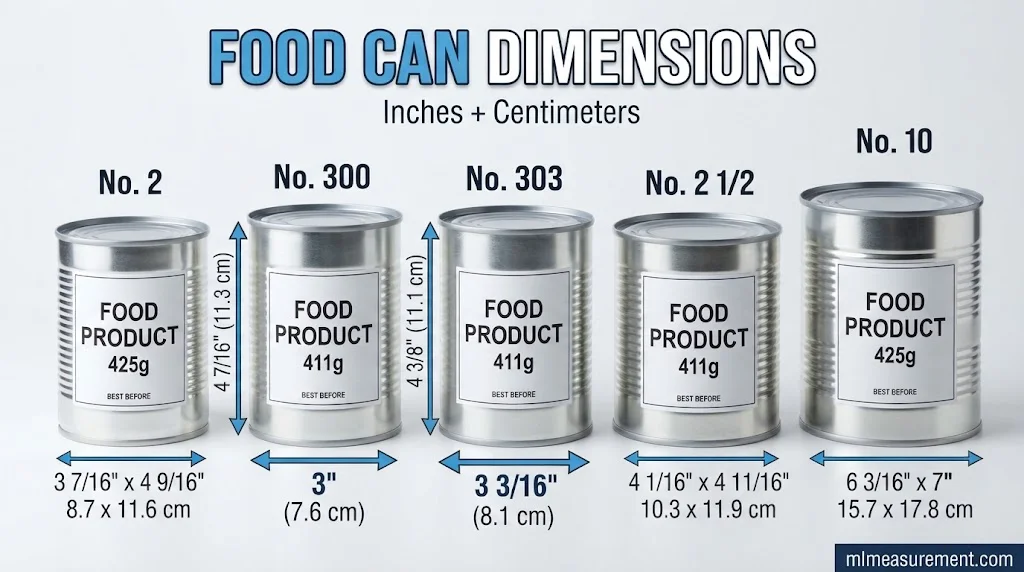
What is the standard size of a food can? Most household cans are about 3″ to 3 3/16″ wide and 4 3/8″ to 4 7/16″ tall (7.6 to 8.1 x 11.1 to 11.3 cm).
Food cans are named by a three-digit code. The Can Manufacturers Institute defines it. The first group is the diameter. The second is the height. Each group is whole inches plus sixteenths.
So 303 x 406 means 3 3/16″ wide and 4 6/16″ tall. It does not mean 3.03″ x 4.06″.
| Can name | Code | Diameter x height (in) | Diameter x height (cm) |
|---|---|---|---|
| No. 1 (Picnic) | 211 x 400 | 2 11/16″ x 4″ | 6.8 x 10.2 |
| No. 300 | 300 x 407 | 3″ x 4 7/16″ | 7.6 x 11.3 |
| No. 303 | 303 x 406 | 3 3/16″ x 4 3/8″ | 8.1 x 11.1 |
| No. 2 | 307 x 409 | 3 7/16″ x 4 9/16″ | 8.7 x 11.6 |
| No. 2½ | 401 x 411 | 4 1/16″ x 4 11/16″ | 10.3 x 11.9 |
| No. 3 Cylinder | 404 x 700 | 4 1/4″ x 7″ | 10.8 x 17.8 |
| No. 5 | 502 x 510 | 5 1/8″ x 5 5/8″ | 13.0 x 14.3 |
| No. 10 | 603 x 700 | 6 3/16″ x 7″ | 15.7 x 17.8 |
Source: USDA Technical Procedures Manual, as listed by Levapack. Centimeters are converted from inches (inches x 2.54).
These are nominal dimensions, so real cans can differ a little by maker. The No. 3 can also comes in a shorter version (404 x 414), according to Shining Packaging.
Food Can Sizes by Name: Capacity, Cups and Common Uses
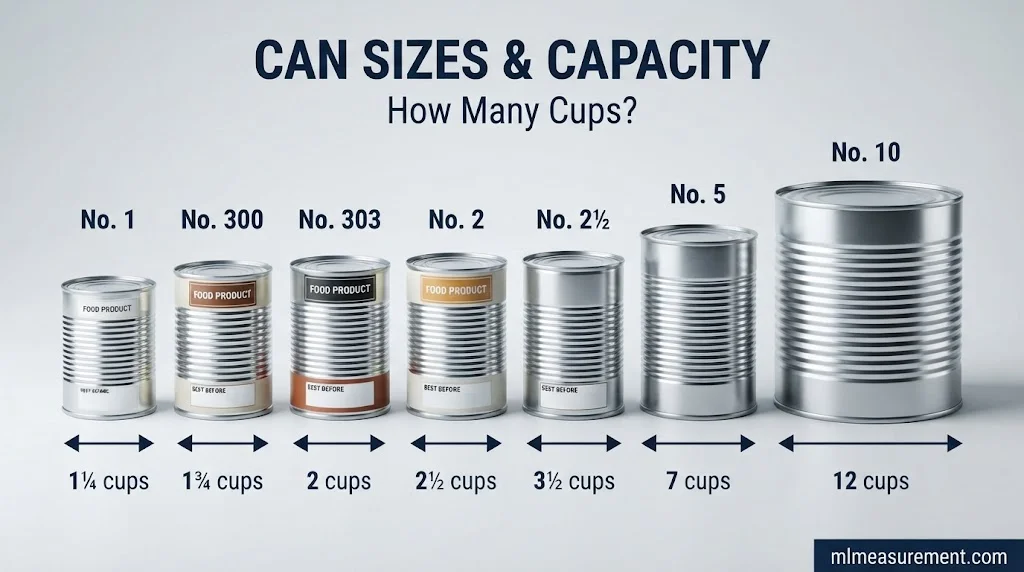
What is the size of a #10 can? It measures about 6 3/16″ x 7″ (15.7 x 17.8 cm). It holds about 3 quarts, or 12 cups, per Nebraska Extension. Restaurants, cafeterias and caterers use it for tomatoes, beans, fruit and sauces.
Food cans are designed around specific dimensions for storage and packaging, but beverage and other aluminum cans follow their own standard measurements. If you need to compare materials, sizes, and profiles, our guide to aluminum can dimensions provides the key height, diameter, and measurement details in both inches and centimeters.
Here is what each size holds:
| Can name | Approx. food weight | Approx. volume | Common foods |
|---|---|---|---|
| No. 1 (Picnic) | 10½–12 oz | 1¼ cups | Small fruit, soup |
| No. 300 | 14–16 oz | 1¾ cups | Beans, soup, cranberry sauce |
| No. 303 | 15–17 oz | 2 cups | Vegetables, fruit, tomatoes |
| No. 2 | 19–20 oz | 2½ cups | Juice, vegetables |
| No. 2½ | 27–29 oz | 3½ cups | Fruit, tomatoes |
| No. 5 | 56 oz | 7 cups | Soup, chili, sauces |
| No. 10 | 6 lb 8 oz–7 lb 5 oz | 3 quarts (12 cups) | Bulk foodservice items |
Sources: Nebraska Extension, Levapack and Shining Packaging. Amounts vary by food and brand.
Three weights are easy to mix up:
- Net weight is the food inside, without the can.
- Drained weight is the food left after the liquid is poured off.
- Tare weight is the empty can.
Also, ounces of weight are not fluid ounces of volume. Peaches, beans and tomato paste all pack differently, so the same can size can hold different weights.
Old recipes may call for a “No. 303 can.” Modern labels show ounces instead. A 303 is close to a 15 or 16 oz can, so it works as a near match.
Tin Can Height and Diameter: Why Food Cans Are Shaped This Way
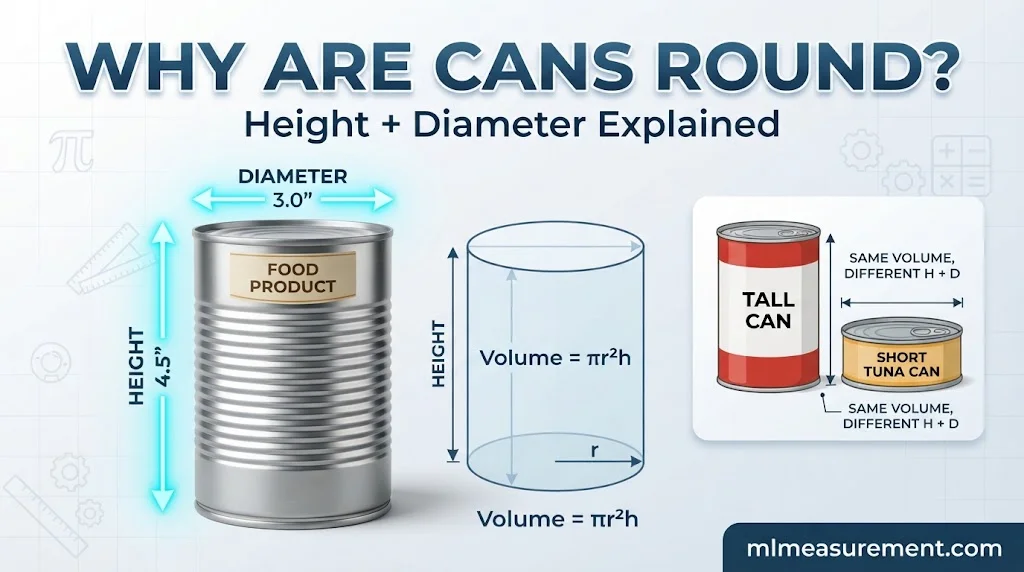
Why are cans round? DataGenetics gives clear reasons. A cylinder has no corners, so it handles pressure well. It sits steady on a shelf. It opens easily and packs well in boxes. Cylinders pack at about 79% efficiency, compared with about 74% for spheres.
The math also says something. For a fixed volume, the can that uses the least metal has a height equal to its diameter.
Real cans are usually taller. DataGenetics measured a few from one pantry:
| Can | Diameter x height (mm) | Diameter x height (cm) | Extra metal vs. ideal |
|---|---|---|---|
| Condensed soup | 65 x 98 | 6.5 x 9.8 | 1.8% |
| Chunky soup | 85 x 107 | 8.5 x 10.7 | 0.57% |
| Condensed milk | 74 x 77 | 7.4 x 7.7 | 0.02% |
| Tuna | 85 x 40 | 8.5 x 4.0 | 6.95% |
Tuna’s short, flat shape wastes the most metal. Condensed milk comes closest to ideal.
So why are many cans taller? Grip, looks and habit all play a part. A taller can is easier to hold. Shoppers also know the shape. These points are the author’s reasoning, not hard rules.
Here is a simple formula to check any can:
Volume = 3.14 x radius² x height
For a No. 300 can, the radius is 1.5″. So the volume is 3.14 x 1.5² x 4.4375, or about 31.4 cubic inches. That is roughly 17.4 fluid ounces.
The listed capacity is lower, about 15.2 fl oz, per Wikipedia. Cans are not filled to the brim. They also have walls, seams and headspace.
How to Measure and Choose the Right Food Can Size
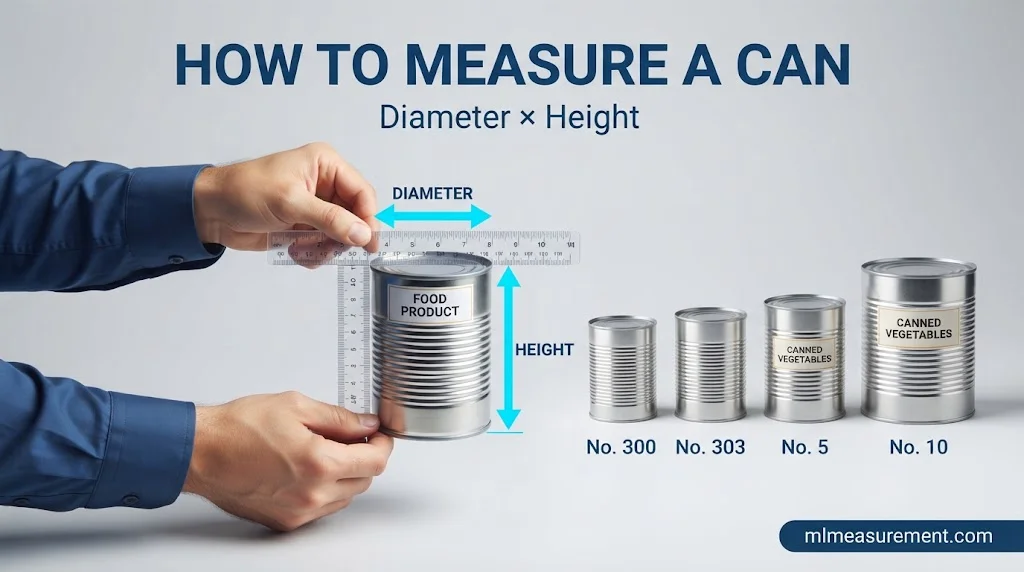
To measure a can, use a ruler or tape. Measure the outside diameter across the widest point. Then measure the height from base to top rim.
Match the size to the job:
- Home cooking: No. 300, No. 303 and No. 2 suit most meals.
- Small kitchens: No. 5 (7 cups) works for soup, chili and sauce.
- Catering and foodservice: No. 10 gives the lowest cost per serving.
- Samples and small portions: No. 1 Picnic is the pick.
Cans differ in build too. Most steel food cans are three-piece. A rolled sheet forms the body, and two ends are attached with a double seam. Wikipedia notes this is the most popular design. Two-piece cans are drawn from one piece and have no side seam.
Cans are usually tinplate (tin-coated steel) or aluminum. A thin lining inside protects the food. Modern steel cans are about 99.5% steel.
They also recycle well. About 65% of steel cans are recycled worldwide. In the US, the rate is 63%.
Before you buy shelves, lids or labels, check the maker’s spec sheet. A code is a good start, but it is not a final spec.
FAQs
What is the standard size of a food can?
There is no single standard. The common retail sizes are No. 300 (3″ x 4 7/16″, or 7.6 x 11.3 cm) and No. 303 (3 3/16″ x 4 3/8″, or 8.1 x 11.1 cm).
What is the standard size of a tin can?
Most “tin cans” are steel cans, so the same sizes apply. No. 300 and No. 303 are the usual picks for household foods.
What is the size of a 10 can?
About 6 3/16″ x 7″ (15.7 x 17.8 cm). It holds about 3 quarts, or 12 cups.
What are the dimensions of a 16 oz can?
A 16 oz food can is usually a No. 303, about 3 3/16″ x 4 3/8″ (8.1 x 11.1 cm). A 16 oz beverage can is different. It is about 2.6″ wide and 6.19″ tall (6.6 x 15.7 cm).
Conclusion
Food can dimensions depend on the can code, from the small No. 1 to the large No. 10. Most home cans measure about 3″ x 4.4″ (7.6 x 11.3 cm). Measure your can, or check the maker’s spec, before you buy storage, labels or packaging.

Rehmaan Khan is a Measurement Content Researcher Specializing in MLmeasurement, Size Guides, Charts, and Simple Educational Measurement Content.