
A regulation baseball field has a 90-foot basepath, a 60 ft 6 in pitching distance, and an outfield fence of 320 to 400+ feet. A regulation softball field has a 60-foot basepath, a 43-foot pitching distance, and a fence of 200 to 250 feet.
This guide gives you every field dimension in feet, by league and age. It also covers how much land you need and how to lay the diamond out.
Table of Contents
Baseball & Softball Field Dimensions at a Glance
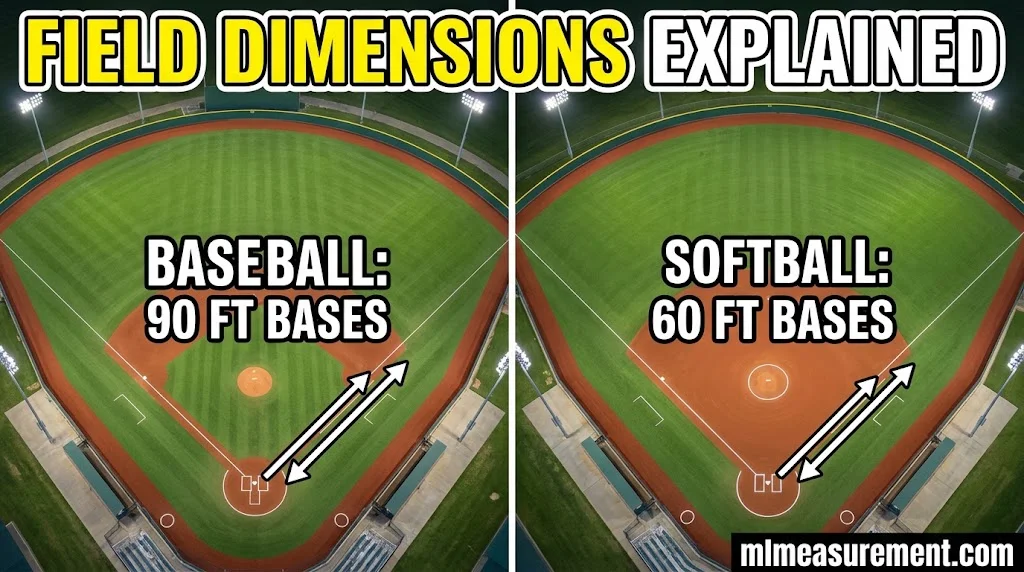
What are the dimensions of a baseball and softball field? Here is the short answer in one chart.
| Measurement | Baseball | Softball |
|---|---|---|
| Basepath | 90 ft | 60 ft |
| Home plate to second base | 127 ft 3⅜ in | 84 ft 10¼ in |
| Pitching distance | 60 ft 6 in | 43 ft |
| Pitching area | Raised mound, 10 in high | Flat 16 ft circle |
| Outfield fence | 320–400+ ft | 200–250 ft |
Why does the infield measure 127 ft 3⅜ in from home to second? The infield is a perfect square with 90-degree corners. The diagonal of a 90-foot square works out to 127.28 feet, which is 127 ft 3⅜ in. Softball uses the same math on a 60-foot square.
Softball is smaller because of the underhand pitch, the larger 12-inch ball, and a faster pace. Shorter distances keep the pitcher and batter matchup fair.
Baseball Field Dimensions by Level
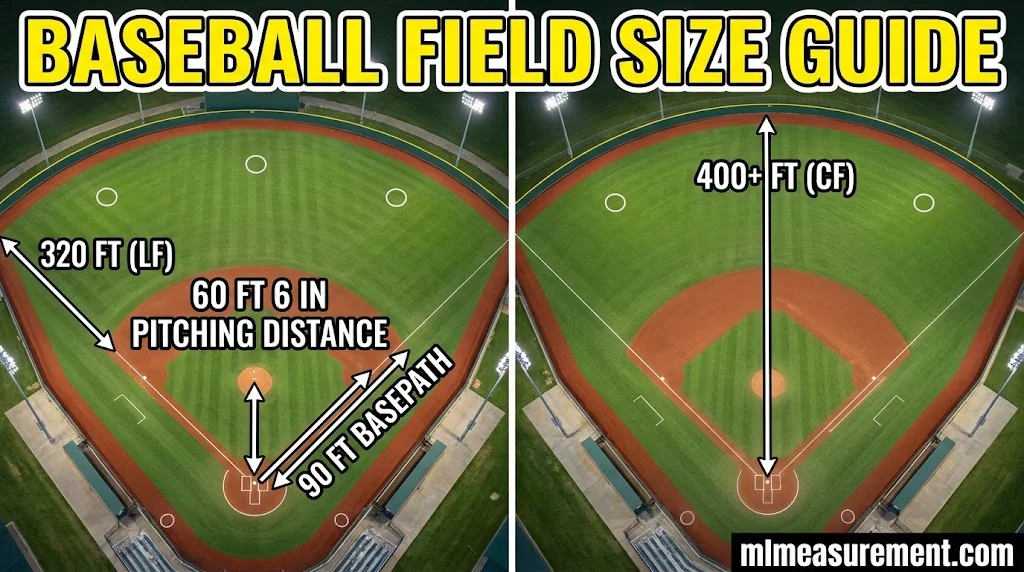
Field size grows with the player. Little League uses 60-foot bases for players 12 and under. Older divisions move up in steps.
After measuring baseball and softball fields, understanding dimensions in everyday spaces can be just as useful. For another practical measurement guide, explore [standard kitchen trash can sizes and dimensions] to learn about typical heights, widths, capacities, and measurements in inches and centimeters
| Level | Basepath | Pitching distance | Fence (recommended) |
|---|---|---|---|
| Little League (Majors and below) | 60 ft | 46 ft | 200 ft |
| Intermediate (50/70) | 70 ft | 50 ft | 200 ft |
| PONY-style 80 ft field | 80 ft | 54 ft | 250–300 ft |
| Junior and Senior League | 75–90 ft | 54–60 ft 6 in | 300 ft |
| High school (NFHS), college (NCAA), MLB, Babe Ruth | 90 ft | 60 ft 6 in | 320 ft or more |
Fence distances for the 80-foot and 90-foot fields come from the Profile Products field chart. MLB parks vary a lot from stadium to stadium.
Other key baseball measurements:
- Pitcher’s mound: 18 ft across and 10 in above home plate on a full-size field.
- Mound slope: a flat 6 inches in front of the pitching rubber, then a drop of 1 inch per foot.
- Skinned infield radius: 95 ft on a 90-foot field.
- Backstop distance: 60 ft on a 90-foot field, and 25 ft on a 60-foot field.
- On-deck circle: 5 ft in diameter.
Softball Field Dimensions and Layout for Every Age
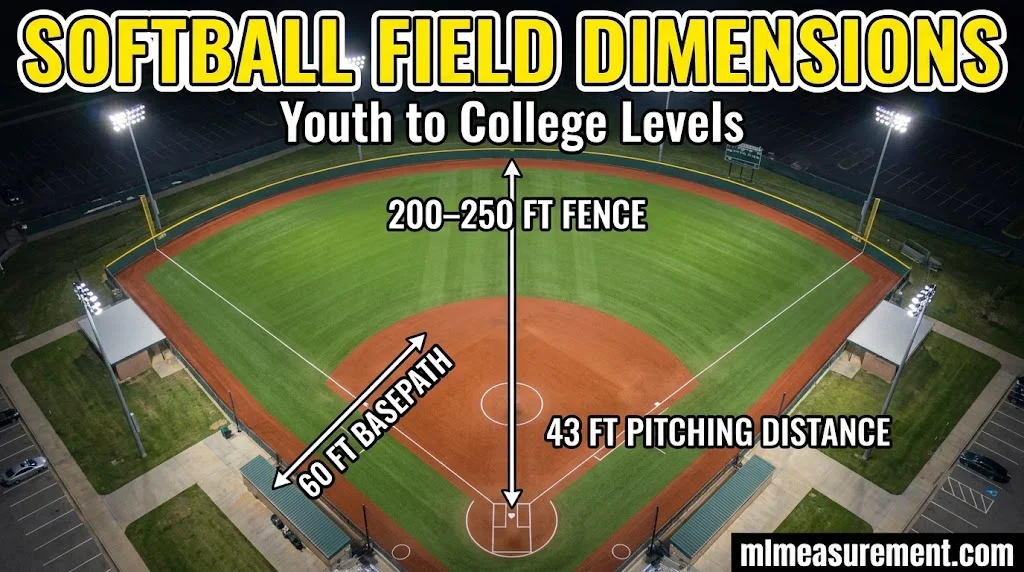
What are the dimensions of a softball field? Bases sit 60 feet apart. Dimensions.com lists a 250-foot fence, an 84 ft 10¼ in infield hypotenuse, and a playing area of about 49,215 square feet.
| Level | Basepath | Pitching distance | Fence |
|---|---|---|---|
| Little League Minors | 60 ft | 35 ft | 200 ft |
| Little League Majors | 60 ft | 40 ft | 200 ft |
| Junior, Senior, high school, college | 60 ft | 43 ft | 200–250 ft |
What are the dimensions of a 12-year-old softball field? It uses 60-foot bases, a 40-foot pitching distance, and a 200-foot recommended fence. That matches the Little League Majors softball division.
Other key softball measurements:
- Pitching circle: 16 ft across.
- Backstop: at least 25 ft behind home plate.
- Skinned infield: at least 3 ft past the foul line before the grass starts.
- Coach’s box: 10 ft by 3 ft, per Dimensions.com.
Some fields use 55-foot or 65-foot basepaths. Always check your league’s rulebook before you build.
How Much Space Does a Field Need? Layout and Measuring Steps
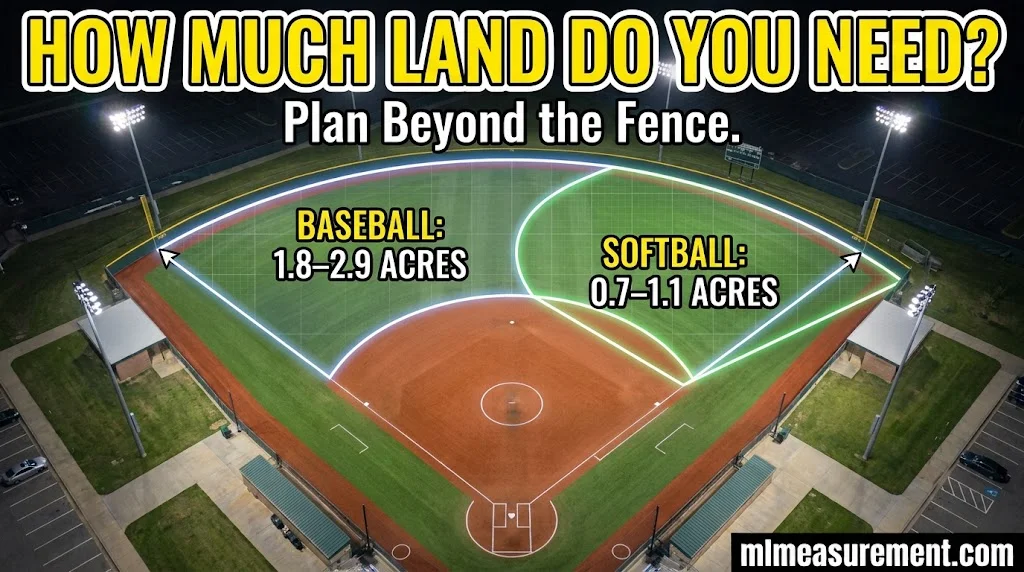
How much space is needed for a softball field? Fair territory is shaped like a quarter circle. Its radius is the fence distance. These are rough numbers for fair ground only:
| Field type | Fence | Fair area (approx.) | Acres |
|---|---|---|---|
| Youth softball or Little League | 200 ft | 31,400 sq ft | 0.7 |
| Softball, 250-ft fence | 250 ft | 49,200 sq ft | 1.1 |
| Full-size baseball | 320 ft | 80,400 sq ft | 1.8 |
| Full-size baseball | 400 ft | 125,700 sq ft | 2.9 |
Add room for foul territory, the backstop, dugouts, and walkways. Plan on more land than the table shows.
Official baseball rules suggest that the line from home plate through the pitcher’s plate to second base run east-northeast. This keeps the sun out of players’ eyes.
How do you lay out a baseball or softball field? Follow these steps:
- Set home plate first. All distances start at its back tip, called the apex.
- Measure to second base. Use 127 ft 3⅜ in for a 90-foot field, or 84 ft 10¼ in for a 60-foot field.
- Stretch two tapes, one from home and one from second. Where they cross, you have first and third base.
- Set the pitching rubber on the line from home to second base.
- Run string along both foul lines out to the fence.
- Mark the batter’s boxes, coach’s boxes, and base cutouts.
Measure to the center of second base, not its front edge. This is a common mistake. Also keep the field level. The only planned slope is the baseball mound. For the infield skin, groundskeepers often use an infield mix with a conditioner such as Turface. Profile Products makes this line.
FAQs
What are the dimensions of a baseball and softball field?
A baseball field has a 90 ft basepath, a 60 ft 6 in pitching distance, and a 320–400+ ft fence. A softball field has a 60 ft basepath, a 43 ft pitching distance, and a 200–250 ft fence.
What are the dimensions of a softball field?
Bases are 60 ft apart. Home to second base is 84 ft 10¼ in. The pitching distance is 43 ft at older levels, with a 16 ft pitching circle and a backstop at least 25 ft back.
How much space is needed for a softball field?
Fair ground alone takes about 0.7 acre with a 200-ft fence and about 1.1 acres with a 250-ft fence. Add space for foul ground, dugouts, and walkways.
What are the dimensions of a 12-year-old softball field?
The bases are 60 ft apart. The pitching distance is 40 ft, and the recommended fence is 200 ft.
Conclusion
Know your league, then match its numbers. Measure from the apex, check your diagonals, and keep the field level. Do that, and the layout will be right the first time.

Rehmaan Khan is a Measurement Content Researcher Specializing in MLmeasurement, Size Guides, Charts, and Simple Educational Measurement Content.